Supply Chain Strategy2026-09-1111 min read
Underwear MOQ by Country: Why Vietnam Asks 5,000+, Bangladesh 1,000+, and China's Small-Batch Clusters Start at 100
Paul PengFactory Technology Director
Part of the Manufacturing Solutions series
Part of the Manufacturing Solutions series
Business insights for apparel brand owners, from production strategies to manufacturing optimization
Services and solutions for your business
Start your underwear brand without the risk. Ready stock from 100 pieces, private label from 100 pieces. No large commitments required.
Learn MoreMen's and women's underwear ready to dispatch. Choose from 6 fabric series. Add your brand label in 7 days.
Learn More
'Which country is best for apparel manufacturing?' costs brands money every time it gets asked — because the answer is a function of three variables, not one: your order stage, your category, and your destination market. Change any one and the correct country flips. This framework walks the three stages (100-piece private-label tests, 500-piece-per-color OEM scaling, 2,000+/10,000+ mass replenishment), maps categories to countries (underwear and fit-driven knits vs. cotton basics vs. performance synthetics), prices in the 2025 tariff reality (US-bound: 20% Vietnam / 20% Bangladesh / ≈45-55% China; RCEP markets: 0% on Chinese origin), and shows why 80%+ of US fashion companies now run dual-country sourcing instead of picking one winner.
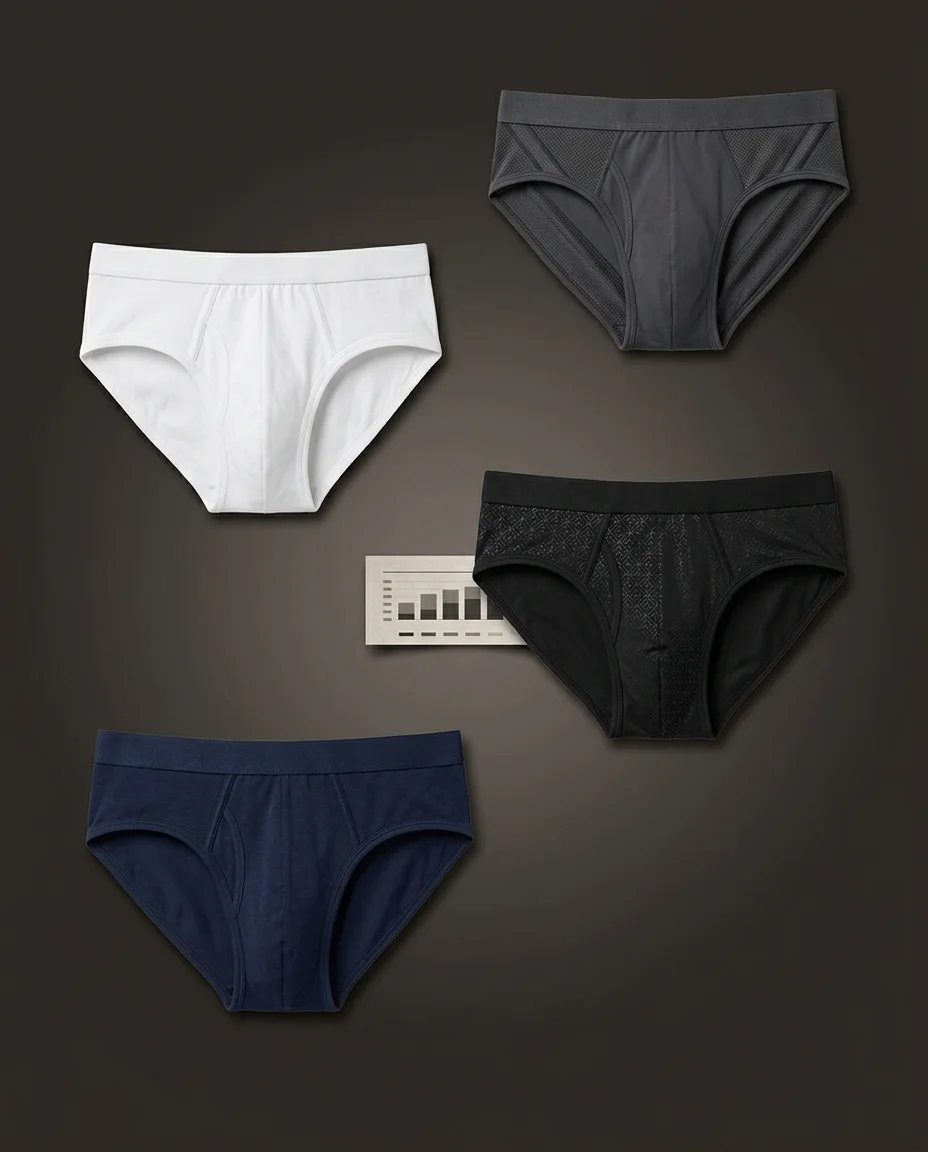
The men's underwear market split from one 'basics' category into four function-specific tracks — and the biggest entry filter is no longer design skill, it's MOQ arithmetic. This decision guide compares the four tracks (budget basics, functional tech, premium fabric, performance sport) with 2026 search data, per-track technology requirements and entry costs — and shows how a two-step sourcing ladder (test at 100 pieces ready-stock private label, scale at 500 pieces full OEM/ODM, vs the industry's 2,000+ norm) changes which track a new brand can actually afford to enter.

Starting a loungewear brand in 2026 is the easiest it has ever been — and the easiest it will ever be again. Modal fabric is widely available, low-MOQ factories (60-set private label) are real, and D2C channels (Shopify, Amazon, Etsy) are mature. We reverse-engineer the playbooks of five brands that built seven-figure loungewear lines — Lunya (premium Modal), SKIMS Sleep (mass social-led), Eberjey (boutique department-store), Cozy Earth (regenerated cellulose celebrity), and SET Active (sweat-set crossover) — and translate them into an OEM vs Wholesale decision tree, a 4-stage launch plan, and a unit-economics model you can run before you commit inventory.
Ask a factory's MOQ and most buyers hear an answer to a different question than the one they think they asked. They hear "how good is this factory?" — reading 100 pieces as "garage operation" and 5,000 pieces as "serious industrial partner." What the number actually reports is which production economics the factory's region is built on — and that is a question about fabric mills, cutting tables, and line balancing, not stitch quality.
The proof is how cleanly MOQ bands cluster by country. Vietnam's full-package exporters publish 5,000-10,000 pieces per style — Thygesen Textile Vietnam, a 92-year-old SA8000/WRAP-certified operator, prints that range on its manufacturing page. Bangladesh's export lines commonly run 1,000-5,000 per style (most book factories at 500-1,000 minimum). The wider industry norm for underwear is 2,000+ per style per color. And in China's Pearl River Delta clusters, 100-piece private label and 500-piece-per-color OEM programs run as standard commercial products.
Same garment category. Same sewing machines, broadly. A 50x spread in minimums — explained by three different regional production models, each rational for the orders it was built to win.
MOQ is a supply-chain-structure variable, not a quality variable. If quality drove MOQ, the band would scatter randomly across factories within each country — it does not; it sorts by country and by production model (CMT export line vs. cluster small-batch vs. private-label stock program). Judge quality with a factory vetting checklist; judge MOQ as a fit-between-your-order-and-their-economics question. Conflating the two leads buyers to over-order inventory they cannot sell.
(Competitor figures are their public claims, not XiaoTex capabilities. XiaoTex figures are our official 2026 policy — the same numbers published across all 11 languages of this site.)
A "factory MOQ" is really a stack of four upstream minimums wearing one number:
1. Fabric comes in mill lots. A knitting mill runs a fabric type efficiently in large batches; a dyeshade gets set up per color lot. Below a certain yardage the price per meter stops making sense — or the mill simply declines the order. Full-package Vietnamese and Bangladeshi programs buy fabric this way, so the fabric minimums land on you.
2. Cutting efficiency is marker math. A cutting table lays a marker (the nested pattern map) across fabric plies. Marker efficiency — how tightly sizes nest — determines fabric waste. Short markers waste more, and tiny cut orders cannot spread set-up across enough plies. Volume is how the cutting room hides waste.
3. Lines are balanced for long runs. A garment line of 25-40 workers hits its hourly output only after a learning curve on one style. A 300-piece order is over before the line peaks. This is why CMT-dominant regions (≈70% of Vietnam's capacity) structure themselves around booked volume programs.
4. The calendar is a queue. Export lines in Bangladesh and Vietnam are typically booked 60-120 days out on seasonal calendars aligned to Western retail. A 500-piece insert order does not just cost more per piece — it often has no slot at any price.
None of this is inefficiency. It is a machine tuned for 50,000-piece purchase orders, and it is genuinely excellent at them — Bangladesh's ≈$39B export sector and Vietnam's ≈$44B were built on exactly this tuning.
The Pearl River Delta inverts every input:
The honest trade-offs, stated plainly: stock-fabric speed limits your fabric and color choices to what the cluster holds; custom fabric development returns you to fabric economics — which is why full custom OEM floors at 500 pieces per color (15-20 days on stock fabric, 45-50 days when fabric must be sourced). Low MOQ is not magic; it is a different point on the flexibility-versus-commitment curve.
"Is that per style, per color, or total order — and what changes at 3x the quantity?" A real low-MOQ program has a coherent answer for both (e.g. 100 pcs private label total; 500 per color for custom, with pricing tiers beyond). A fake one — a trading company relaying to a volume line — goes vague, because the underlying factory has a 2,000+ gate and the 'low MOQ' is a loss-leader to capture your RFQ.
Underwear is a fit-and-fabric category where the cost of being wrong compounds: wrong size curve and you own returns; wrong fabric and you own reviews. The ladder exists to buy information before committing inventory:
Test at 100 — private label, ≈$1.00-1.50/piece. $100-150 at risk per style-color. Your label on proven blocks (men's cotton, modal, cooling; women's cotton/modal/no-show programs), dispatching in as little as 7 days. You are buying sell-through data: which styles move, what sizing feedback says, whether the fabric story resonates.
Scale at 500 — full OEM/ODM, ≈$1.50-3.00/piece per color. $750-1,500 committed per color. Now the winners get custom fabric (including regenerated-cellulose and cooling knits), custom construction (pouch and gusset engineering), grading, and branding — on 15-20 day stock-fabric or 45-50 day sourced-fabric calendars.
Reorder at volume — where South Asia earns its slot. Once a style is proven at retail and you are quoting 10,000+ piece replenishment, the Bangladesh/Vietnam wage ladder (≈$113-195/month vs. China's ≈$230-375) can dominate the math, tariff treatment depending. The three-country comparison covers that stage; this article covers the two stages before it.
The industry's 2,000+ gate collapses steps 1 and 2 into a single $4,000+ bet placed before you have one data point. That is not discipline — that is inventory financing dressed as commitment.
Start a 100-piece test or send your style, fabric target, and launch window for a ladder quote.
Related reading: China vs Bangladesh vs Vietnam: The 2026 Comparison (the full seven-dimension country table) · How to Choose Your Garment Manufacturing Country (the stage-based framework) · 100 Pieces Underwear Supplier Guide (test-order execution) · Balancing MOQ and Production Costs (the unit-cost math) · Seamless Underwear Manufacturing Costs & MOQ (why seamless has its own machine economics).
Sources: Thygesen Textile Vietnam 5,000-10,000 pcs/style MOQ, SA8000/WRAP certification, and 92-year operating history from their published custom-underwear manufacturing page (competitor public claim, not an XiaoTex capability); GYKNIT "industry usually 3,000+" and 500-piece private-label claim from their published wholesale-underwear page (competitor public claim); DiYaSi 120-piece MOQ at $1.59/piece, 5-7 day sampling and 15-30 day bulk from their published OEM page (competitor public claim); Bangladesh MOQ norms per SDF Clothing ("most factories require 500 to 1,000 pieces per style"), Elron Garments and White Cotton MOQ surveys (Asian factories 500-5,000 units per style per color, up to 10,000); Vietnam ≈70% CMT share and fabric-import structure per B-Company raw-material risk analysis; wage figures (Bangladesh 12,500 BDT ≈$113 per FLA; Vietnam ≈$155-195 regional per Talentnet; China ≈$230-375 per China Briefing 2025-2026 schedules); export scale (Bangladesh ≈$39B BGMEA; Vietnam ≈$44B VITAS/Ascentium) as compiled in our country comparison; XiaoTex MOQ/price/lead-time figures are official site-wide policy (100 pcs private label ≈$1.00-1.50; 500 pcs/color OEM ≈$1.50-3.00; 7-day / 15-20 day / 45-50 day dispatch bands). Competitor figures are point-in-time public claims — re-verify at inquiry.