Manufacturing Guide2026-05-0314 min read
Seamless Underwear Manufacturing: Technology, Costs & MOQ Guide for Brands
Karl XiaoFactory Production Director
Part of the Manufacturing Solutions series
Part of the Manufacturing Solutions series
Business insights for apparel brand owners, from production strategies to manufacturing optimization
Ready-to-ship product series related to this article
Services and solutions for your business
Start your underwear brand without the risk. Ready stock from 100 pieces, private label from 100 pieces. No large commitments required.
Learn MoreMen's and women's underwear ready to dispatch. Choose from 6 fabric series. Add your brand label in 7 days.
Learn More
Buyers read MOQ as a quality signal — '100 pieces must mean a garage operation; 5,000 pieces must mean a serious factory.' Both inferences are wrong. MOQ is regional production economics, not craftsmanship: Vietnam's full-package giants state 5,000-10,000 pieces per style (Thygesen's published rate), Bangladesh export lines run 1,000-5,000, and the wider industry asks 2,000+ — while China's Pearl River Delta clusters hold ready-stock fabric and mixed small-batch lines that make 100-piece private label ($1.00-1.50/piece) and 500-piece-per-color OEM ($1.50-3.00/piece) commercially real. This guide breaks down the line economics behind each number, what 'low MOQ' actually costs you in trade-offs, and the 100 → 500 test-and-scale ladder for underwear brands.

'Which country is best for apparel manufacturing?' costs brands money every time it gets asked — because the answer is a function of three variables, not one: your order stage, your category, and your destination market. Change any one and the correct country flips. This framework walks the three stages (100-piece private-label tests, 500-piece-per-color OEM scaling, 2,000+/10,000+ mass replenishment), maps categories to countries (underwear and fit-driven knits vs. cotton basics vs. performance synthetics), prices in the 2025 tariff reality (US-bound: 20% Vietnam / 20% Bangladesh / ≈45-55% China; RCEP markets: 0% on Chinese origin), and shows why 80%+ of US fashion companies now run dual-country sourcing instead of picking one winner.
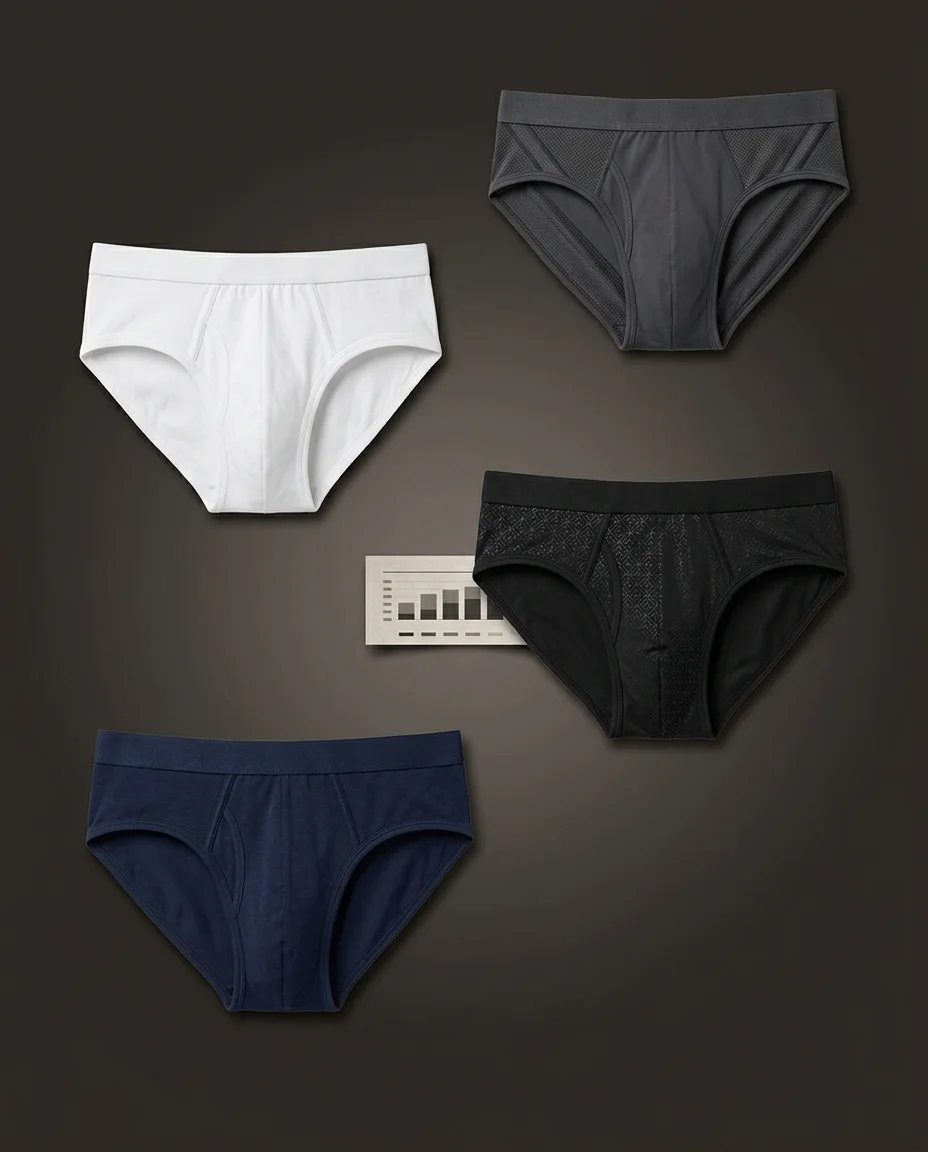
The men's underwear market split from one 'basics' category into four function-specific tracks — and the biggest entry filter is no longer design skill, it's MOQ arithmetic. This decision guide compares the four tracks (budget basics, functional tech, premium fabric, performance sport) with 2026 search data, per-track technology requirements and entry costs — and shows how a two-step sourcing ladder (test at 100 pieces ready-stock private label, scale at 500 pieces full OEM/ODM, vs the industry's 2,000+ norm) changes which track a new brand can actually afford to enter.
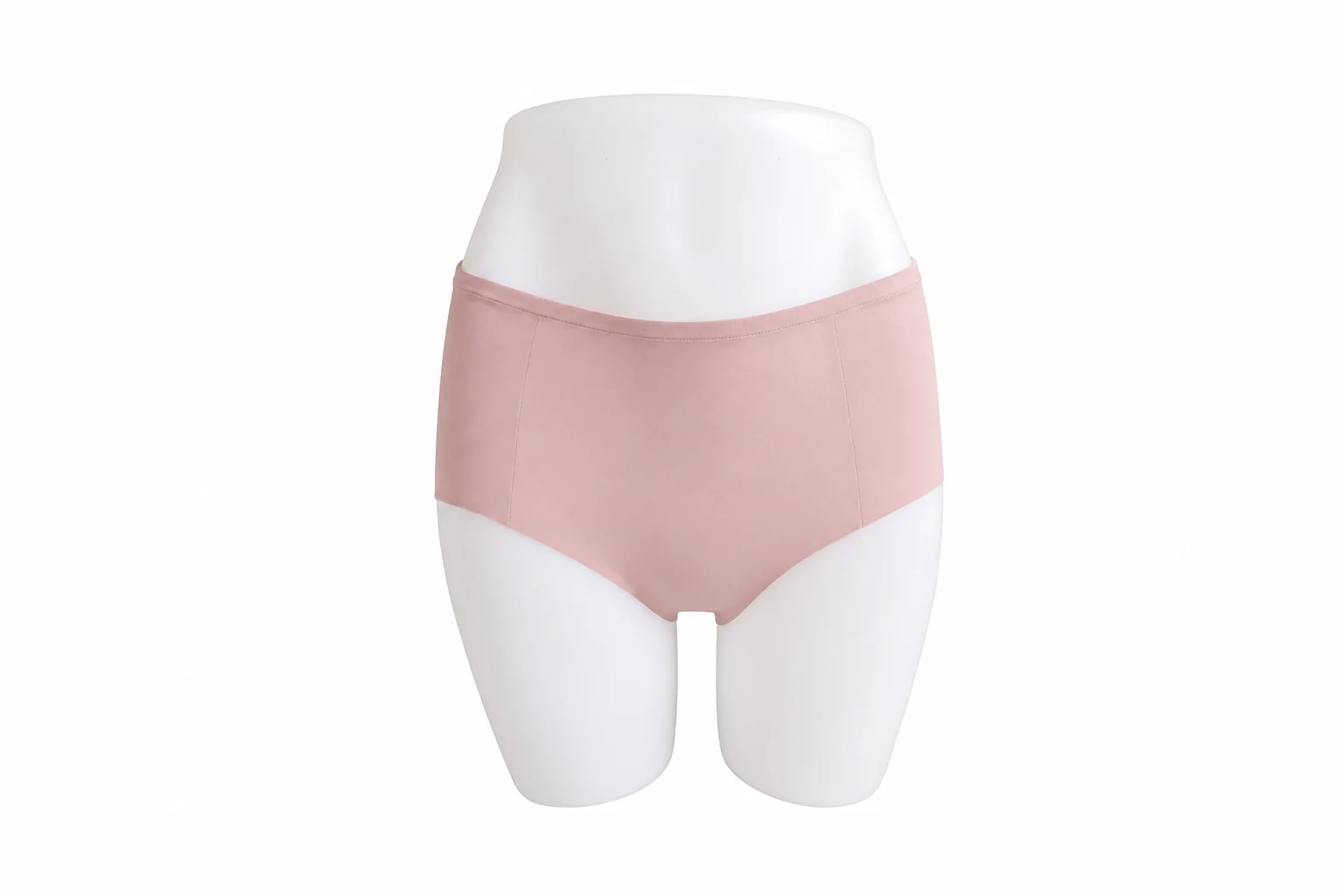
The seamless underwear market is growing at unprecedented speed. Men's seamless underwear searches have surged over 300%, plus-size seamless categories have grown 250%, and D2C brands are scrambling to add seamless lines to their catalogs. But behind the consumer-facing "no side seams" promise lies a manufacturing process with fundamentally different economics from traditional cut-and-sew production.
This guide focuses on what matters most to brand owners and sourcing managers: what seamless underwear actually costs to produce, why MOQs are higher, and how to decide whether seamless is the right production method for your line. For the technology fundamentals — how Santoni circular knitting works, leg opening finishing techniques, and fabric science — see our Seamless Underwear Technology Guide.
Seamless underwear factory gate cost ranges from $1.80 to $3.50 per unit, depending on yarn quality, finishing technique, and order volume. The cost structure is fundamentally different from cut-and-sew because the largest cost driver is machine time, not labor.
A new Santoni SM8-TOP2 costs $80,000-$120,000. At typical utilization rates (70-80% capacity, 20 working days/month), machine depreciation alone accounts for $0.08-$0.15 per unit. This is why seamless manufacturers require higher MOQs — the machine must run at sufficient volume to amortize this fixed cost. Factories with older, fully-depreciated machines can offer lower unit prices but may have limited gauge options and slower production speeds.
The machine time component is the single biggest differentiator between seamless and cut-and-sew economics. In traditional manufacturing, labor (cutting and sewing operators) is the dominant cost. In seamless, the knitting machine itself is the bottleneck and the cost center. This has direct implications for MOQ, lead time, and pricing — which we break down in the sections below.
Not all seamless underwear is created equal, and the machine type used in production directly affects product capabilities, minimum order size, and unit cost. Three Santoni machine types dominate the industry:
The Santoni knitting workflow follows a precise sequence from yarn loading to finished blank:
Santoni machines are typically scheduled in production blocks. If your order requires a specific gauge or machine type that is fully booked, lead time can extend by 2-3 weeks. Confirm machine availability early in the negotiation process, especially during peak season (August-November for spring/summer launches).
Seamless underwear MOQ is inherently higher than cut-and-sew because of machine setup costs. Each new style/color combination requires program loading, yarn threading, and sample approval — a process that takes 2-4 hours regardless of order size. This fixed setup cost must be spread across the production run.
FOB price decreases significantly as order volume increases
The price gap between Tier 1 and Tier 3 is substantial — up to 36% savings per unit when scaling from 200 to 1,000+ units. For brands planning to re-order, the economics favor placing a larger initial order or committing to a re-order schedule that unlocks Tier 3 pricing.
Some manufacturers, including XiaoTex, offer 100-unit trial orders at a 20-30% premium over standard 200-unit pricing. These are designed for brands that need physical samples for photoshoots, focus groups, or investor presentations before committing to a full production run. The premium covers the disproportionate setup cost spread across fewer units.
For a deeper analysis of how MOQ constraints interact with startup capital and cash flow, see our guide on Balancing MOQ and Production Costs for Startup Brands.
The most common question from brands evaluating seamless production: "Is seamless worth the higher production cost?" The answer depends on your retail price point, target margin, and brand positioning. Here is the full unit economics breakdown:
Key takeaways from the comparison:
Seamless costs 40-60% more at factory gate but commands 50-100% higher retail prices. A seamless brief at $2.80 factory gate selling for $22 yields an 87% gross margin. A comparable cut-and-sew brief at $1.90 selling for $14 yields an 86% margin. The margin percentages are similar, but the absolute dollar margin per unit is higher for seamless ($19.20 vs $12.10).
Labor savings are real but offset by machine cost. Seamless eliminates 4-6 sewing operations per garment, reducing labor to $0.15-$0.30/unit. However, the Santoni machine time cost ($0.55-$1.20/unit) more than compensates for this saving.
Quality consistency is seamless's hidden advantage. Cut-and-sew production is operator-dependent — sewing tension, stitch count, and alignment vary between operators and shifts. Seamless quality is machine-programmed, producing near-identical garments across an entire production run. This reduces defect rates (typically 2-3% for seamless vs 5-8% for cut-and-sew) and returns.
Design flexibility favors cut-and-sew. Changing a cut-and-sew style means modifying a pattern — a hours-long process. Changing a seamless style means reprogramming the Santoni machine — potentially a days-long process. If your brand values rapid style iteration, cut-and-sew offers more agility.
Fabric waste is one of the most misunderstood aspects of seamless production. Many assume that "knitting directly into shape" means zero waste, but the reality is different.
Cut-and-sew achieves higher utilization through marker optimization
Why seamless utilization is lower (70-75%) vs cut-and-sew (80-85%):
Size transition waste: When the Santoni machine transitions between sizes during a production run, it generates transitional waste yarn that cannot be recovered. This is analogous to the "ramp-up" scrap in other manufacturing processes.
Density adjustment waste: Circular knitting dynamically adjusts stitch density across body zones (waistband vs body vs leg). Each density transition consumes yarn that is partially wasted because the transition zone does not meet product specifications.
No marker optimization: Cut-and-sew benefits from computer-aided marker making — arranging pattern pieces like a puzzle to maximize fabric usage. Seamless has no equivalent optimization because the fabric is formed directly, not cut from a flat bolt.
Cost impact calculation:
Consider a Modal/spandex seamless brief with 25% fabric waste at a yarn cost of $8/kg. Each garment uses approximately 50g of yarn. At 75% utilization, the effective yarn consumption is 50g / 0.75 = 66.7g per unit. The waste cost per unit is 16.7g x $8/1000g = $0.13/unit in wasted yarn. Across a 1,000-unit order, that is $130 in pure material waste — not catastrophic, but significant when multiplied across multiple styles and re-orders.
For cut-and-sew at 83% utilization, the same calculation yields 50g / 0.83 = 60.2g per unit and a waste cost of $0.08/unit. The difference of $0.05/unit may seem small, but it compounds across high-volume orders and contributes to the overall cost premium of seamless production.
One of the most strategic decisions for brands entering the seamless category is choosing the right entry point. Too small an order means high unit costs and limited market feedback. Too large an order means capital tied up in inventory before validating demand.
Investment: $560-$700 (FOB only) Best for: Market validation, photoshoot samples, focus group testing
Start with one or two styles in your strongest color. Use overlock finishing to keep costs down at this stage. The goal is not profit — it is data. How does the fit perform across body types? Which size sells fastest? What feedback do early customers give on comfort and durability?
Risk mitigation: At 200 units, your maximum exposure is under $1,000 including shipping. Even if the product fails to find product-market fit, the financial loss is manageable.
Investment: $1,150-$1,450 (FOB only) Best for: E-commerce launch, initial ad spend testing, building size/color matrix
Five hundred units allows you to offer 2-3 colors and a full size range (XS-2XL). You can now test which color-size combinations are your winners. Consider upgrading to laser-cut finishing for your hero style — the premium is justified by stronger marketing imagery and customer reviews.
Risk mitigation: 500 units across 5 sizes and 2 colors means approximately 50 units per size-color combination. This is lean enough to avoid dead stock while providing sufficient inventory for 2-3 months of sales data.
Investment: $1,800-$2,500 (FOB only) Best for: Proven demand, re-order cycles, wholesale channel development
At 1,000+ units, you unlock the most favorable pricing and full customization options. You can offer 4+ colors, laser-cut finishing across all styles, and custom packaging. This is also the volume where third-party testing through SGS or Intertek becomes cost-effective — the per-unit testing cost drops below $0.05 at this scale.
Risk mitigation: Only scale to this tier after 500-unit sales data confirms demand. Use the 500-unit phase to identify your best-selling size-color combinations and concentrate the 1,000-unit order toward proven winners rather than expanding into unproven variants.
We support and cooperate with clients to perform third-party laboratory testing through SGS, Intertek, and other accredited labs. At 1,000+ unit orders, per-unit testing costs drop significantly. We recommend testing for color fastness (ISO 105-C06), dimensional stability (ISO 6330), and pH value (ISO 3071) as a baseline compliance package for any market. We do not hold OEKO-Tex or BSCI certifications — instead, we facilitate client-requested third-party testing for each production batch to ensure compliance with your specific market standards.
For brands deciding between starting with stock products vs custom development, see our analysis of White Label vs. Full Customization for a detailed comparison of risk profiles and time-to-market.
Seamless underwear manufacturing operates on fundamentally different economics than cut-and-sew. The Santoni machine is both the enabler and the constraint — it creates superior product consistency and eliminates seam-related defects, but it demands higher MOQs, carries significant setup costs, and produces more fabric waste.
The core economic trade-off is clear: seamless costs 40-60% more to produce but commands 50-100% higher retail prices, delivering comparable or better absolute dollar margins. For brands targeting the $15-$30 retail price point, seamless is not just a product feature — it is a margin strategy.
The path to profitability in seamless runs through volume. A 200-unit test order at $2.80/unit is a learning investment. A 1,000+ unit re-order at $1.80/unit is where the margin economics become compelling. The brands that win in seamless are the ones that use small initial orders to gather data, then scale aggressively into proven winners.
If you are evaluating seamless underwear manufacturing for your brand, XiaoTex offers a complete production pipeline from 200-unit trial orders through full-scale ODM programs. Our Santoni-equipped facility in Zhongshan supports SM8-TOP2 and SM9 production across standard and fine gauges, with laser-cut and overlock finishing options. Every production batch can be supported by third-party testing through SGS or Intertek to meet your market compliance requirements. Contact us to discuss your seamless production needs.
Data Sources: This article is based on Santoni machine technical specifications and depreciation schedules, factory production cost accounting data, fabric utilization benchmarks from circular knitting and marker-making operations, and retail pricing analysis across 50+ seamless underwear brands in the US and European markets.