Brand Growth2026-08-2312 min read
How to Start a Loungewear Brand in 2026: OEM vs Wholesale (Lunya / SKIMS Playbook)
Leo PengTechnical Advisor
Part of the Manufacturing Solutions series
Part of the Manufacturing Solutions series
Business insights for apparel brand owners, from production strategies to manufacturing optimization
Services and solutions for your business

Buyers read MOQ as a quality signal — '100 pieces must mean a garage operation; 5,000 pieces must mean a serious factory.' Both inferences are wrong. MOQ is regional production economics, not craftsmanship: Vietnam's full-package giants state 5,000-10,000 pieces per style (Thygesen's published rate), Bangladesh export lines run 1,000-5,000, and the wider industry asks 2,000+ — while China's Pearl River Delta clusters hold ready-stock fabric and mixed small-batch lines that make 100-piece private label ($1.00-1.50/piece) and 500-piece-per-color OEM ($1.50-3.00/piece) commercially real. This guide breaks down the line economics behind each number, what 'low MOQ' actually costs you in trade-offs, and the 100 → 500 test-and-scale ladder for underwear brands.

'Which country is best for apparel manufacturing?' costs brands money every time it gets asked — because the answer is a function of three variables, not one: your order stage, your category, and your destination market. Change any one and the correct country flips. This framework walks the three stages (100-piece private-label tests, 500-piece-per-color OEM scaling, 2,000+/10,000+ mass replenishment), maps categories to countries (underwear and fit-driven knits vs. cotton basics vs. performance synthetics), prices in the 2025 tariff reality (US-bound: 20% Vietnam / 20% Bangladesh / ≈45-55% China; RCEP markets: 0% on Chinese origin), and shows why 80%+ of US fashion companies now run dual-country sourcing instead of picking one winner.
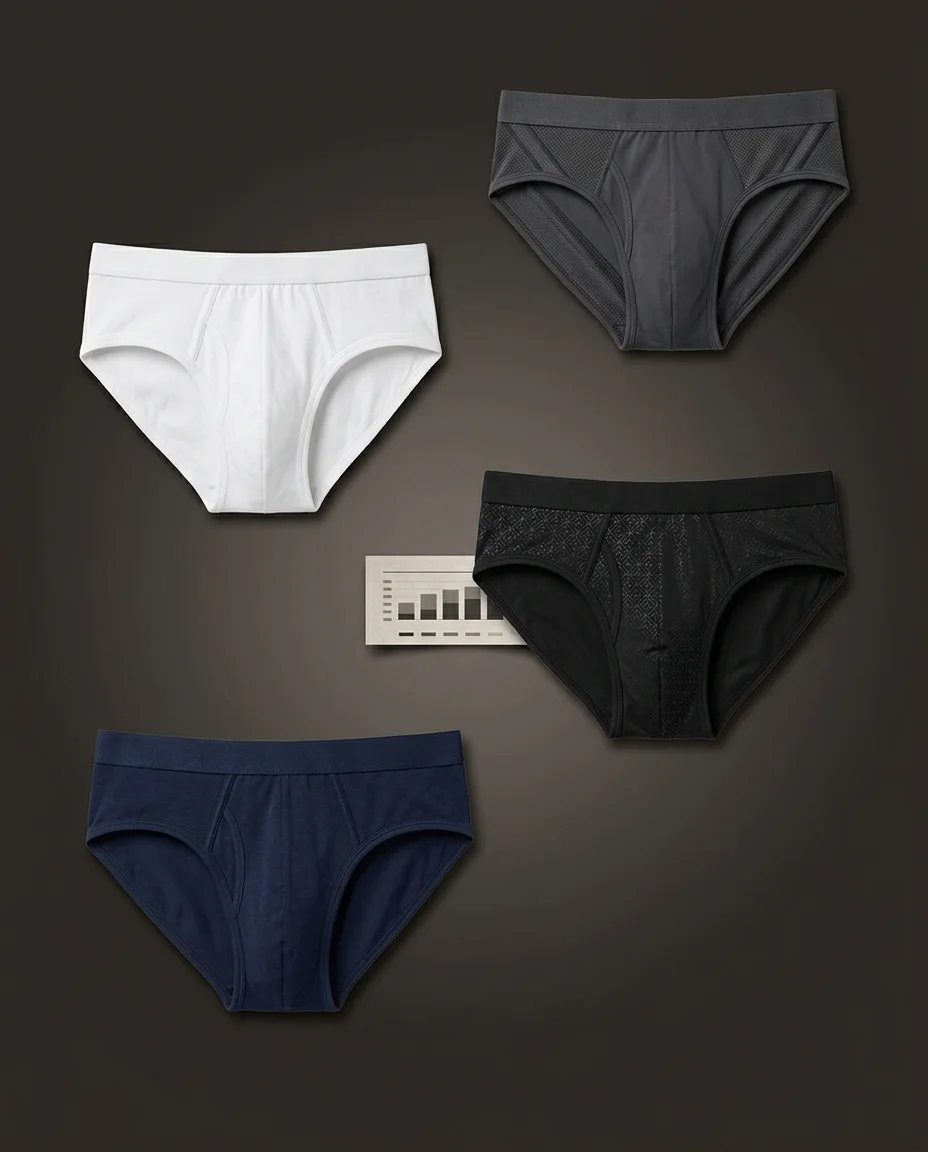
The men's underwear market split from one 'basics' category into four function-specific tracks — and the biggest entry filter is no longer design skill, it's MOQ arithmetic. This decision guide compares the four tracks (budget basics, functional tech, premium fabric, performance sport) with 2026 search data, per-track technology requirements and entry costs — and shows how a two-step sourcing ladder (test at 100 pieces ready-stock private label, scale at 500 pieces full OEM/ODM, vs the industry's 2,000+ norm) changes which track a new brand can actually afford to enter.
Starting a loungewear brand in 2026 is the easiest it has ever been. Modal fabric is widely available. Low-MOQ factories that take 60-set orders are real. D2C channels (Shopify, Amazon, Etsy) are mature, with off-the-shelf theme + app stacks that get you to a working store in a weekend. At the same time, the category is growing at 8.86% CAGR (loungewear-only) to 13.5% CAGR (silk pajamas sub-segment), with men's loungewear up +200% YoY in search — see Loungewear Market 2026 for the data.
This guide reverse-engineers the playbooks of five brands that built seven-figure loungewear lines, then translates them into an OEM vs Wholesale decision tree, a 4-stage launch plan, and a unit-economics model you can run before you commit inventory. If you are an Amazon FBA seller, a Shopify founder, or a small brand adding a loungewear capsule, the framework is the same.
Different brands have built winning loungewear businesses with very different models. Here are the five most-studied playbooks and what each teaches.
None of these brands launched with wholesale. None launched with custom fabric development. None launched with 1,000-piece minimums. All five started D2C, on stock or near-stock fabric, with a focused silhouette (Modal pajama set, cotton sweat set, or silk sleep set), and scaled only after they had real sales data. This is the test-and-scale path described in our 100-piece sourcing guide.
New brands often get a boutique or small retail account early and think "wholesale is the path." It is — but not at launch. Wholesale pricing is typically 50-60% of your D2C retail, which compresses margin dramatically. More importantly, wholesale demands inventory consistency and color/fit stability across seasons that you cannot deliver without already having operational maturity. The brands that built durable wholesale (Eberjey, Lake Pajamas) all started D2C for 2-4 years first.
Here is the workflow we recommend for every new loungewear brand in 2026. Total time: 8-12 weeks from idea to first sale if you start with private label.
After Stage 4 you have one of three outcomes:
Here is a realistic unit-economics model for a 2026 D2C Modal pajama set, assuming the private-label 60-set tier with a stock Modal body.
When you scale from 100-piece private label to 500-piece OEM, lock the fabric spec. Same Modal-spandex 95/5, same 180 GSM, same enzyme-wash finish, same anti-pilling grade. If you switch fabrics at scale to save $1-2 per unit, your return rate will spike from 8% to 20%+ within a month as customers notice the drape, softness, and recovery change. The $500-1,000 you saved on fabric you will lose on returns + damaged brand trust. We have seen this exact pattern play out repeatedly.
The biggest single decision in Stage 1 is which silhouette to start with. Three criteria:
Even at the 60-set private-label tier — where the garment itself is a factory body — your brand identity is yours to build. Five elements are non-negotiable:
The single biggest private-label mistake is treating it as a "generic product with my label slapped on." Your label, hangtag, packaging, color names, and care-label copy are the entire brand experience at this tier. Spend the same care on them as you would on a custom-designed garment. Brands that win at private label (Comfrt, Lake Pajamas early years) treat the branding layer as the product.
XiaoTex is a loungewear and sleepwear OEM/ODM factory in Zhongshan, Guangdong. Our model is structured specifically for the 4-stage launch plan above:
We do not hold OEKO-Tex or BSCI certification. Instead we ship order-level compliance documentation and explicitly support third-party lab testing for your specific orders. We work this way because most 2026 loungewear customers (Amazon, EU, US marketplaces) require order-level documentation, not blanket certification.
If you are planning to launch a loungewear brand — Modal sets, men's capsule, crushed velvet, silk sleepwear, or any of the 12 trending niches — explore our loungewear manufacturing service or talk to our team about your test-and-scale plan.
Related reading: Loungewear Market 2026: Size, Growth & Where Brand Demand Is Moving · Loungewear Fabric Science: Modal, Cotton & Regenerated Cellulose · 12 Trending Loungewear Niches for 2026 · Low MOQ Loungewear Manufacturer: 100-Piece Guide · The Men's Loungewear Boom (+200%).