Supply Chain Strategy2026-09-1111 min read
How to Choose Your Garment Manufacturing Country: A Stage-Based Framework (Test at 100 → Scale at 500 → Mass at 2,000+)
Paul PengFactory Technology Director
Part of the Manufacturing Solutions series
Part of the Manufacturing Solutions series
Business insights for apparel brand owners, from production strategies to manufacturing optimization
Services and solutions for your business
Start your underwear brand without the risk. Ready stock from 100 pieces, private label from 100 pieces. No large commitments required.
Learn MoreMen's and women's underwear ready to dispatch. Choose from 6 fabric series. Add your brand label in 7 days.
Learn More
Buyers read MOQ as a quality signal — '100 pieces must mean a garage operation; 5,000 pieces must mean a serious factory.' Both inferences are wrong. MOQ is regional production economics, not craftsmanship: Vietnam's full-package giants state 5,000-10,000 pieces per style (Thygesen's published rate), Bangladesh export lines run 1,000-5,000, and the wider industry asks 2,000+ — while China's Pearl River Delta clusters hold ready-stock fabric and mixed small-batch lines that make 100-piece private label ($1.00-1.50/piece) and 500-piece-per-color OEM ($1.50-3.00/piece) commercially real. This guide breaks down the line economics behind each number, what 'low MOQ' actually costs you in trade-offs, and the 100 → 500 test-and-scale ladder for underwear brands.
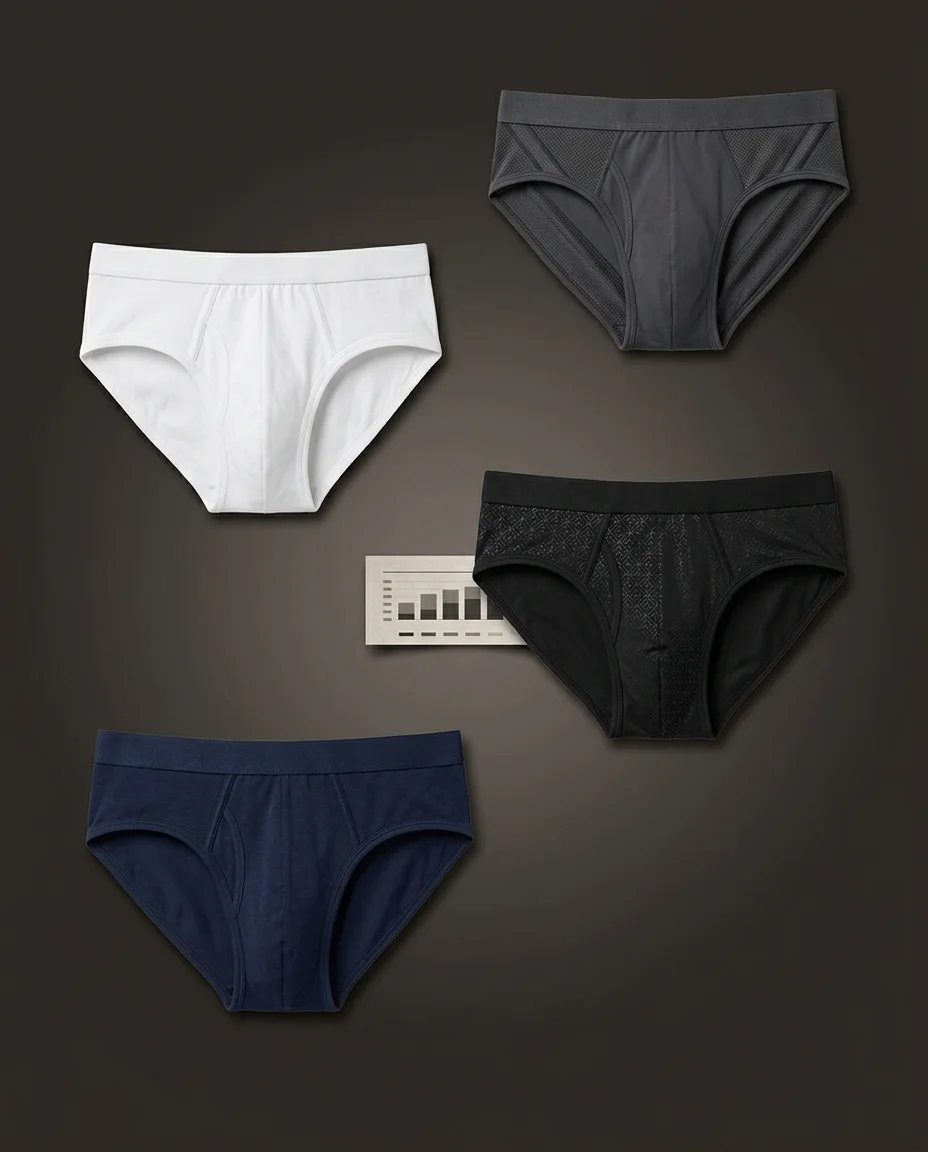
The men's underwear market split from one 'basics' category into four function-specific tracks — and the biggest entry filter is no longer design skill, it's MOQ arithmetic. This decision guide compares the four tracks (budget basics, functional tech, premium fabric, performance sport) with 2026 search data, per-track technology requirements and entry costs — and shows how a two-step sourcing ladder (test at 100 pieces ready-stock private label, scale at 500 pieces full OEM/ODM, vs the industry's 2,000+ norm) changes which track a new brand can actually afford to enter.

Starting a loungewear brand in 2026 is the easiest it has ever been — and the easiest it will ever be again. Modal fabric is widely available, low-MOQ factories (60-set private label) are real, and D2C channels (Shopify, Amazon, Etsy) are mature. We reverse-engineer the playbooks of five brands that built seven-figure loungewear lines — Lunya (premium Modal), SKIMS Sleep (mass social-led), Eberjey (boutique department-store), Cozy Earth (regenerated cellulose celebrity), and SET Active (sweat-set crossover) — and translate them into an OEM vs Wholesale decision tree, a 4-stage launch plan, and a unit-economics model you can run before you commit inventory.
"Which country is best for making clothing?" is the most expensive question in apparel sourcing — not because it is hard, but because it is malformed. It asks for a single answer to a three-variable function. The correct country for your brand is determined by your order stage (what you are proving), your category (where its differentiation lives), and your destination market (what duty treatment each origin receives). Change one variable and the answer flips: the right factory country for a 300-piece underwear launch in Jakarta is the wrong one for a 30,000-piece tee program in Los Angeles.
The industry's own behavior confirms it: 80%+ of US fashion companies spent 2024-2025 actively reducing China exposure — yet China remained the world's largest apparel exporter at ≈$165B, because those same companies did not leave; they staged their sourcing across countries. The winners stopped asking "which country" and started asking "which country, for this."
This article is the framework we walk buyers through: three stages, a category map, a destination-market tariff table, and the dual-country operating model.
A country-selection method is only useful if it gives different answers to different orders. This framework's output changes when quantity, category, or destination changes — that is what makes it testable against your own quotes. Any method that returns the same country for every order is not a framework; it is a preference wearing one.
A first production run is not manufacturing; it is buying information. The information you need: which styles sell, what your market's size feedback says, whether the fabric story converts. What you do not need: 2,000 pieces of anything.
That reframes country selection entirely. At 100-500 pieces, the comparisons that dominate mass sourcing — wage differentials of $0.10-0.30 per piece — are rounding errors against the risks that actually kill first launches: fit drift you cannot iterate on, 90-day calendars that miss the season, and $4,000+ inventory bets placed on zero data.
This is the stage where the three countries are not even comparable. Bangladesh's practical floor (most export lines 1,000+ pieces per style) and Vietnam's full-package giants (Thygesen publishes 5,000-10,000) are structurally absent from the test-order market. Chinese cluster manufacturing built its whole model here: ready-stock private label from 100 pieces (your label on proven blocks, dispatching in as little as 7 days) and small-batch OEM at 500 pieces per color. For underwear — where the pouch and gusset engineering and fabric hand define the brand — the cluster's fabric inventory and one-roof development are the stage's decisive assets.
The execution playbook for this stage is our 100-piece supplier guide; the MOQ mechanics by country are covered in the MOQ country comparison.
Between 500 and 2,000 pieces per style, your product is mostly proven but still moving: grading gets corrected, waistband tension tunes, a second fabric weight tests for a seasonal variant. Every change is a mini-development cycle, and development cycles are where cluster supply chains compound their advantage — stock-fabric OEM turning around in 15-20 days, sourced-fabric in 45-50 days, with the fabric mill, dyehouse, trim maker, and sewing floor in one region.
Unit-cost math at this stage: moving a 1,000-piece style from a Chinese cluster to Bangladesh might save $0.10-0.25 per piece in sewing — $100-250 per thousand — while adding a development iteration cycle measured in months and a second QC regime to stand up. For most brands in stage 2, that trade loses. The exceptions that justify an early move: pure cotton basics with frozen specs, or US-bound programs where the 2025 tariff differential (below) exceeds the transition cost.
At 2,000-10,000+ pieces of a proven style, the variables invert. Nothing is being learned; the style is being executed. Now the numbers that were rounding errors compound into the decision:
Freeze three things in writing before moving a proven style to a second country: (1) the complete tech pack with construction diagrams; (2) tolerance tables — symmetry and measurement limits the new factory must hold (China's T/CTCA 8-2020 seamless-underwear tolerance framework is a usable reference format); (3) the graded size curve from your actual sales data. Without those, the cheaper factory re-introduces the fit drift you already paid to eliminate, and the savings convert into returns.
Differentiation lives in construction and fiber — gussets, pouches, regenerated-cellulose and cooling knits — and order sizes start small. Develop and test in Chinese clusters; only cotton-basic volume styles graduate to South Asia. Bra-category manufacturing is its own specialization regardless of country.
Once proven, these are wage-ladder products. Bangladesh's ≈4M-worker knit sector at the lowest wages is the unit-cost floor for cotton programs; China clusters remain the answer below ~2,000 pieces or when decoration (print, embroidery, wash) is the differentiator.
Vietnam's FDI-built full-package sector — anchored by the suppliers behind the big sportswear brands — is the strongest at technical synthetics and certification-heavy programs (SA8000/WRAP operators), at 1,000-10,000 piece minimums. China competes on fabric innovation at smaller quantities.
Two 2025 changes to price into any US-bound model: the $800 de minimis exemption ended — first for China-origin parcels (May 2025), then for all countries (August 2025) — closing the ship-parcels-direct-from-factory workaround that small e-commerce sellers used; and the tariff gap itself, which is why we tell US-market buyers with volume programs to run the three-country landed-cost comparison honestly, even as a China-based factory.
This is what "diversification" looks like when it is done deliberately rather than reactively:
Stage your program. Develop, sample, and test in one country (the fast, low-MOQ cluster); replenish proven volume from the lowest landed-cost origin for your destination. One 100-piece test and one 20,000-piece reorder do not need the same factory — or the same country.
Standardize the paperwork across both sites. One tech pack format, one tolerance framework, one testing protocol — per-order third-party testing (SGS/Intertek) at both factories. This is what makes the second factory a copy of the first rather than a lottery.
Freeze the fit before transfer. The graded size curve from real sales data locks before mass migration. Fit drift between origin factories is the number-one hidden cost of dual sourcing.
Re-run the country math at every stage boundary. Tariff schedules, wages, and freight move — the 2025-2026 tariff sequence proved that twice. The framework's variables are stage, category, and destination; refresh their values, not the method.
We occupy the stage-1/stage-2 position in this framework and say so plainly: a Zhongshan (Pearl River Delta) OEM/ODM factory running private label from 100 pieces (≈$1.00-1.50/piece, 7-day dispatch) and full OEM/ODM from 500 pieces per color (≈$1.50-3.00/piece; 15-20 days stock fabric, 45-50 days sourced) — while most of the industry gates at 2,000+. We hold no OEKO-Tex/BSCI certificates and support per-order SGS/Intertek testing instead. When your program graduates to stage-3 US-bound mass volume where the 2025 tariff table favors another origin, we will tell you that in the quote — and for ASEAN, Korea, EU, Japan, and Gulf destinations, the RCEP/FTA route through us is usually the cheapest landed path. That honesty is the business model: see the series or send your stage, category, and destination for a framework-honest quote.
Related reading: China vs Bangladesh vs Vietnam: The 2026 Comparison (the seven-dimension country table) · Underwear MOQ by Country (the MOQ mechanics behind stage 1) · How to Vet a T-Shirt Factory: A Transparency Checklist (the audit that applies in every country) · How to Create Your Own Lingerie Brand (RCEP/Form E execution) · 100 Pieces Underwear Supplier Guide (stage-1 execution).
Sources: China ≈$165B 2024 apparel exports and country rankings from trade-data compilations (TradeInt; New Way Apparel); 80%+ US sourcing-diversification trend per Printful statistics as cited in our supply-chain transparency guide; wages per FLA (Bangladesh 12,500 BDT ≈$113, Dec 2023), Talentnet (Vietnam regional ≈$155-195, +7.2% Jan 2026), China Briefing (China ≈$230-375); MOQ benchmarks from Thygesen (5,000-10,000/style, published), SDF Clothing (Bangladesh 500-1,000 norm, published), GYKNIT ("industry usually 3,000+", published), and XiaoTex official policy (100 private label / 500 per color OEM vs industry 2,000+); US tariff framework per Executive Order 14257 (April 2, 2025), July 2025 Vietnam deal (20%), August 7, 2025 Bangladesh modification (20%), China trajectory (145% May 2025 peak, ≈45-55% many lines, -10 points November 10, 2025) per Sheng Lu Fashion analyses and Dimerco; de minimis termination (China-origin May 2025; all countries August 2025) per the same executive-action record; RCEP/Form E 0% ASEAN duty vs ≈15% standard, China-Korea FTA, ACFTA, and GCC 5% from our export documentation as described in the lingerie-brand guide; EU EBA (Bangladesh) and EVFTA (Vietnam) preferential access per European Commission trade schedules; T/CTCA 8-2020 tolerance framework per the indexed standard text as cited in our pouch construction guide. Tariff and wage figures are point-in-time — re-verify at order placement.