Supply Chain Strategy2026-08-1511 min read
How to Vet a T-Shirt Factory: A Transparency Checklist for Brand Owners
Paul PengFactory Technology Director
Part of the Manufacturing Solutions series
Part of the Manufacturing Solutions series
Business insights for apparel brand owners, from production strategies to manufacturing optimization

Buyers read MOQ as a quality signal — '100 pieces must mean a garage operation; 5,000 pieces must mean a serious factory.' Both inferences are wrong. MOQ is regional production economics, not craftsmanship: Vietnam's full-package giants state 5,000-10,000 pieces per style (Thygesen's published rate), Bangladesh export lines run 1,000-5,000, and the wider industry asks 2,000+ — while China's Pearl River Delta clusters hold ready-stock fabric and mixed small-batch lines that make 100-piece private label ($1.00-1.50/piece) and 500-piece-per-color OEM ($1.50-3.00/piece) commercially real. This guide breaks down the line economics behind each number, what 'low MOQ' actually costs you in trade-offs, and the 100 → 500 test-and-scale ladder for underwear brands.

'Which country is best for apparel manufacturing?' costs brands money every time it gets asked — because the answer is a function of three variables, not one: your order stage, your category, and your destination market. Change any one and the correct country flips. This framework walks the three stages (100-piece private-label tests, 500-piece-per-color OEM scaling, 2,000+/10,000+ mass replenishment), maps categories to countries (underwear and fit-driven knits vs. cotton basics vs. performance synthetics), prices in the 2025 tariff reality (US-bound: 20% Vietnam / 20% Bangladesh / ≈45-55% China; RCEP markets: 0% on Chinese origin), and shows why 80%+ of US fashion companies now run dual-country sourcing instead of picking one winner.
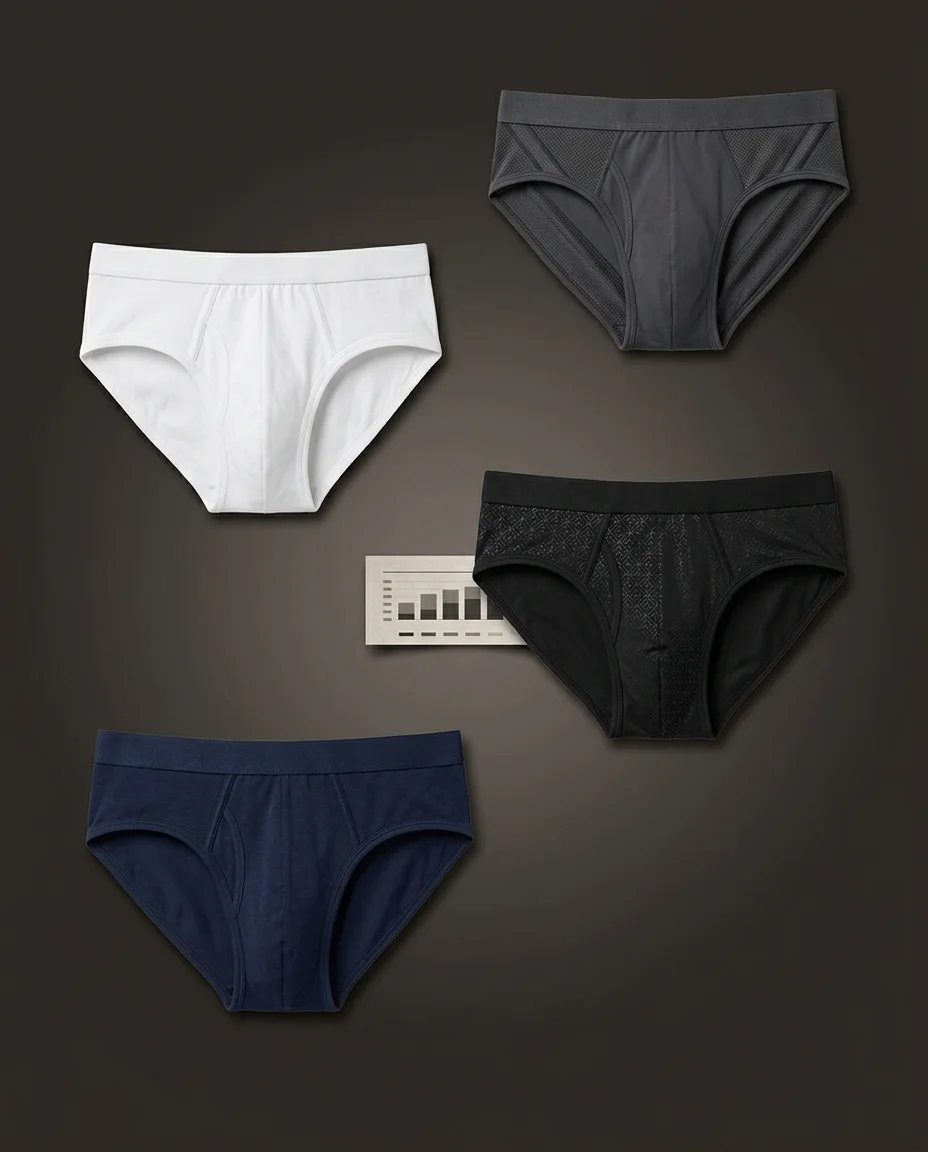
The men's underwear market split from one 'basics' category into four function-specific tracks — and the biggest entry filter is no longer design skill, it's MOQ arithmetic. This decision guide compares the four tracks (budget basics, functional tech, premium fabric, performance sport) with 2026 search data, per-track technology requirements and entry costs — and shows how a two-step sourcing ladder (test at 100 pieces ready-stock private label, scale at 500 pieces full OEM/ODM, vs the industry's 2,000+ norm) changes which track a new brand can actually afford to enter.
China made 29% of the world's T-shirts in 2024 — more than double Bangladesh, the second-largest producer — and has led global T-shirt manufacturing for 14 consecutive years (Printful). At the same time, 80%+ of US fashion companies have been actively working to reduce China sourcing, diversifying across Bangladesh, India, Vietnam, and near-shore options.
Both facts are true, and together they define what matters in 2026: the factories that retain share are the transparent ones. When brands diversify, they spread smaller test orders across countries and compare on data — capacity, sampling speed, compliance documentation, communication. The factory that answers specific questions with specific answers wins; the one that answers with slogans loses.
This article gives you the eight-dimension checklist we recommend brand owners use to vet any T-shirt factory, the red flags that should end a conversation, and why the compliance question is best answered with per-order third-party testing rather than a factory-wide certificate.
Dominant share — but sourcing is diversifying
A vetting-ready T-shirt factory should be able to answer specifically on each of these. If any answer is vague, that dimension is a risk.
Transparency is not the factory volunteering every detail up front — it is the factory answering specific questions with specific answers. A factory that says it depends is not necessarily dishonest, but it has not earned your order yet. Push for specifics before committing.
Compliance is where most brand owners ask the wrong question. They ask, "Do you have OEKO-Tex / BSCI?" — when the better question is, "How will you document compliance for my specific order?"
XiaoTex does not hold OEKO-Tex or BSCI certification. We will not claim we do. What we offer is per-order third-party laboratory testing through SGS or Intertek, so the chemical-safety and fiber-content documentation you use at retail is specific to the batch you actually ship. For Amazon, EU REACH, US CPSIA, and most marketplace requirements, this is the documentation that holds up.
The 80%+ US sourcing-reduction trend is real, and a transparent factory addresses it directly rather than papering over it.
Geopolitical risk, tariff uncertainty, and single-supplier concentration risk. Brands spread smaller test orders across countries to compare before committing volume.
Small-batch test capability (100 pcs), fast sampling, broad decoration under one roof, and compliance documentation per batch — so each test order is comparable.
Vertical integration, cluster-level supply-chain completeness (yarn → dye → garment → trim in one region), and the ability to handle complex value-added processes at affordable cost. Speed and breadth, not lowest unit price.
Brands optimizing purely for lowest unit cost on simple tees will find cheaper options elsewhere. The retained-China segment competes on agility, transparency, and compliance — not price.
When you diversify sourcing across countries, use the same vetting checklist for each. The factory that gives you the most specific answers across the eight dimensions — regardless of country — is the one most likely to be a reliable partner. Country is a starting filter; transparency is the deciding factor. For the numbers behind that filter — wages, MOQ bands, 2025 tariffs, vertical integration — see our China vs Bangladesh vs Vietnam comparison and the stage-based country-selection framework.
One transparency dimension that honest factories address is raw-material price volatility. Cotton prices swing with weather and trade policy (the US ban on Xinjiang cotton, for example, materially moved global cotton prices); synthetic fiber prices fluctuate with oil; logistics and tariffs add further variability.
A transparent factory explains why a quote moves between sample and bulk, or between orders — cotton spiked, the dollar shifted, a tariff changed. A factory that holds a fixed price for 90 days without explaining how it is absorbing raw-material risk is either subsidizing the order to win it (and will recover the cost later) or planning to substitute fabric. Transparent pricing builds the trust that makes a long-term partnership possible. Our Zhongshan facility is in Guangdong (not a Xinjiang-cotton region), and we disclose sourcing origin in compliance conversations.
Many "factories" online are trading companies that resell another factory's capacity. This is not inherently bad, but it changes the transparency math: a trading company cannot give you first-hand answers on production process or quality control. If direct production transparency matters to you, verify you are talking to the factory that actually makes the goods.
To make this actionable, here is a question set you can send any T-shirt factory as a first filter:
Capacity & MOQ. "What is your MOQ per style for private label, and for OEM/ODM? What is your monthly capacity, and what is your current utilization?"
Speed. "How many days from tech pack approval to sample? How many days from bulk order confirmation to shipment, at the quantity I am planning?"
Supply-chain control. "Which steps are in-house — fabric sourcing, cut-and-sew, print, embroidery, wash, labeling? Which are partnered, and with whom?"
Compliance. "How do you document compliance for my target market? Do you support per-order third-party testing (SGS, Intertek), and what is the process and cost?"
Quality. "What QC runs before shipment, and at what AQL level? Can I receive inspection photos or a third-party inspection report?"
Samples. "Can I order a physical sample of the exact body and spec I am considering, before committing to bulk?"
A transparent factory answers all six in writing, in specifics, within a day or two. That response — more than any sales deck — is the real vetting signal.
XiaoTex is a T-shirt factory in Zhongshan, Guangdong — the Pearl River Delta cluster that anchors China's 29% global production share. Here is how we answer the eight dimensions:
In a market where China leads on scale (29% of global production, 14 years at #1) and buyers simultaneously diversify sourcing, the factory that wins your business is the one that answers specific questions with specific answers. Three takeaways:
If you are vetting T-shirt factories and want a partner that answers in specifics — including on compliance — send us your tech pack and target MOQ. We will answer the checklist in writing and quote the sample.
Data Sources: China's 29% share of global T-shirt production (2024, 14-year #1 tenure) and the 80%+ US sourcing-reduction trend per Printful industry statistics (2026); cotton-price volatility (including the Xinjiang-cotton ban effect on global cotton prices) per Credence Research T-Shirts Market Report; factory vetting framework synthesized from industry sourcing guides and the XiaoTex factory's compliance policy (CLAUDE.md §3).