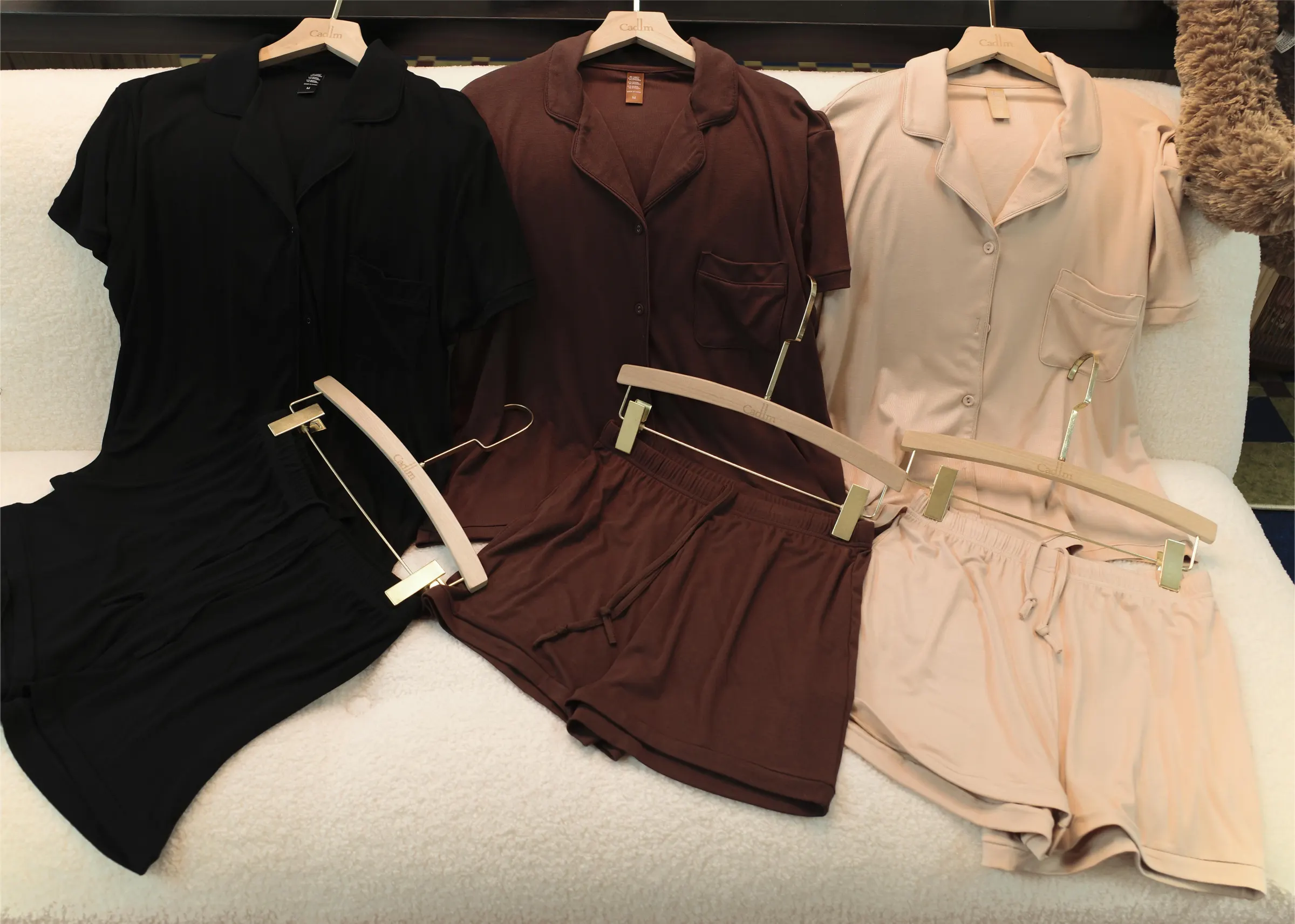
Sleepwear is a high-margin category for D2C apparel brands. XiaoTex produces pajama sets, nightgowns, sleep shirts, and silk sleepwear using charmeuse, modal, and breathable cotton. Full OEM/ODM service with low MOQ.
What We Deliver
MOQ: 60 sets — real silk from 30 sets — unified for private label and full OEM
Fabric expertise: silk charmeuse, modal, regenerated cellulose, cotton poplin
Pajama sets, nightgowns, sleep shirts, robes, and lounge dresses
Lace trim, piping, embroidery, and printing customization
Private label, woven labels, custom packaging
Fabrics & Craft
Core fabric programs we currently run. Anything not listed can be developed to your spec.
- Fabric
- 100% Cotton Poplin
- Craft
- yarn-dyed cotton poplin, pre-shrunk
- MOQ
- 60 sets
- Lead Time
- 15-20 days
Third-party lab testing available (SGS / Intertek)
Deep Dives
Practical guides on fabrics, craftsmanship, and sourcing.
Women's Sleepwear 2026 (+250%): The Biggest Segment, Cut Into Six Underserved Niches
Women's sleepwear is the single biggest segment in the category and it is still accelerating: Google Trends (July 2026, worldwide, Past year) shows 'women's sleepwear' at 100 search interest (+250% YoY), 'women's pajama set' at 100 (+400%), 'sleepwear set' 70 (+100%), 'sleepwear & intimates' Breakout, 'lace sleepwear' +130%, 'satin sleepwear' 21 (+70%), 'sleepwear dress' 28 (+60%), 'nursing sleepwear' +170%, 'vintage sleepwear' +200%, and 'plus size sleepwear' +20%. Yet most brands chase the saturated middle. We cut women's sleepwear into six underserved niches where D2C brands can still win: the summer short-set niche, the lace/romantic niche, satin-as-accessible-silk, the nursing/maternity niche, the plus-size niche, and the vintage/luxury-positioning niche — plus the brand-competition signals (Victoria's Secret sleepwear +800%, Skims +170%, Soma +170%) that show where the D2C opening sits.
Reversible Pajamas: How 'Two Looks in One Set' Is Actually Sewn (The OEM Construction Guide)
Reversible pajamas — 'two looks in one set', flip it inside out and the satin face becomes a printed cotton face — are a merchandising gift to sleepwear brands: double the perceived value, a built-in 'for every mood' story, and a natural gift and travel product. What the product page never explains is that reversibility is a seam-engineering achievement, not a fabric choice. A true two-fabric reversible set runs on bagged-out seams and doubled seam allowances, tagless labels, two-way elastics, and trims finished on both faces — and it dies in the wash from one failure the spec sheet can predict: differential shrinkage between the two faces (cotton 3-5% vs satin 1-2%) puckering the seams after wash three. This guide maps the three reversible construction routes, the seam and trim engineering, the spec conflicts between the two faces, the cost reality, and the decision framework for brands considering a 2-in-1 sleepwear program.
Pajamas for Night Sweats and Hot Sleepers: A Fabric Ranking That Separates Wicking from Just Absorbent
Night sweats turn pajama choice into a fabric-engineering problem — and the intuitive answer (cotton, because it's 'breathable') is wrong for the worst nights. Cotton absorbs sweat and holds it; what a hot sleeper needs is moisture transport (wicking), rapid drying, and minimal cling. This guide ranks the seven fabric families sleepwear brands actually choose among — cotton jersey, cotton-modal, 100% modal/lyocell, regenerated-cellulose blends, lightweight wool, polyester performance knits, and silk — on wicking vs absorption, dry time, cling, and wash durability, with the OEM spec behind each tier and the consumer claims that hold up (and the ones that don't). Built for brands serving menopause, perimenopause, pregnancy, and hot-sleeper segments: the highest-loyalty sleepwear niches, where the right fabric creates a repeat customer and the wrong one creates a return.
Men's Sleepwear Capsule: The Fabric and Block Map for an Underserved, Fast-Growing Category
Men's sleepwear is the fastest-rising sleepwear query cluster on Google Trends (July 2026, worldwide): 'men's sleepwear' +400%, 'silk pajamas men' variants +30% quarter-over-quarter, and the men's pajama segment growing while women's flattens — yet most D2C catalogs still treat men's as a single plaid-pant SKU. This OEM guide maps the men's sleepwear capsule the way a factory builds it: the four fabric directions (cotton jersey, cotton-modal blend, woven flannel, washable silk-look satin) with GSM specs, the four block types (sleep pant, knit set, woven classic set, sleep short + tee), the details men actually return garments over (waistband, fly, pocket depth, length shrinkage), and a 60-set-per-block launch plan for brands testing the category.
Kids' Sleepwear Safety & Compliance: Snug-Fitting vs Flame-Resistant (US 16 CFR 1615/1616, EU, AU)
Kids' sleepwear is one of the most regulated apparel categories — and one of the fastest-growing: Google Trends (July 2026, worldwide, Past year) shows 'kids sleepwear' +80%, 'baby sleepwear' +40%, 'girls sleepwear' +40%, 'kids pajamas' at 38 interest (+20%), 'baby pajamas' 31 (+30%), 'toddler pajamas' 18, and 'pajamas for kids' +60%. But the same regulation that makes kids' sleepwear safe also makes it the easiest category to get wrong: in the US, children's sleepwear sizes 9 months through 14 is governed by CPSC 16 CFR Parts 1615 (sizes 0-6X) and 1616 (sizes 7-14), requiring sleepwear to be EITHER flame-resistant OR meet snug-fitting dimensions. This guide explains the two compliance routes, the snug-fitting pattern-block specification, the mandatory yellow hangtag, the EU (EN 14878) and Australia equivalents, and how to spec kids' sleepwear correctly from the design stage — not as a labeling afterthought.
Flannel vs Fleece Pajamas: Which Is Warmer, Which Pills, and the OEM Spec View
Flannel and fleece are the two default winter pajama fabrics — and most brands pick between them using hand-feel instead of specs. Flannel is a woven, brushed cotton (or CVC) fabric measured in GSM and napping passes; fleece is a knitted, sheared-pile synthetic measured in 100/200/300 weight classes. The difference drives warmth character (breathable-warm vs heat-trapping), shrinkage (cotton flannel can lose 5% in one hot wash; fleece barely shrinks), pilling (napped cotton vs anti-pill polyester), print methods, kids' sleepwear compliance, and landed cost. This OEM guide puts the two fabrics side by side with the GSM bands, wash-test standards, and spec-template language a factory actually needs — plus the customer-archetype decision framework for Q4 pajama programs.