Supply Chain Strategy2026-05-0316 min read
How to Start an Underwear Brand in 2026: Complete OEM/ODM Manufacturing Guide
Paul PengFactory Technology Director
Part of the Manufacturing Solutions series
Part of the Manufacturing Solutions series
Business insights for apparel brand owners, from production strategies to manufacturing optimization
Services and solutions for your business
Turn our ready stock into YOUR branded product. Choose styles, send your logo, and receive fully branded underwear in 7 days.
Learn MoreStart your underwear brand without the risk. Ready stock from 100 pieces, private label from 100 pieces. No large commitments required.
Learn More
Buyers read MOQ as a quality signal — '100 pieces must mean a garage operation; 5,000 pieces must mean a serious factory.' Both inferences are wrong. MOQ is regional production economics, not craftsmanship: Vietnam's full-package giants state 5,000-10,000 pieces per style (Thygesen's published rate), Bangladesh export lines run 1,000-5,000, and the wider industry asks 2,000+ — while China's Pearl River Delta clusters hold ready-stock fabric and mixed small-batch lines that make 100-piece private label ($1.00-1.50/piece) and 500-piece-per-color OEM ($1.50-3.00/piece) commercially real. This guide breaks down the line economics behind each number, what 'low MOQ' actually costs you in trade-offs, and the 100 → 500 test-and-scale ladder for underwear brands.

'Which country is best for apparel manufacturing?' costs brands money every time it gets asked — because the answer is a function of three variables, not one: your order stage, your category, and your destination market. Change any one and the correct country flips. This framework walks the three stages (100-piece private-label tests, 500-piece-per-color OEM scaling, 2,000+/10,000+ mass replenishment), maps categories to countries (underwear and fit-driven knits vs. cotton basics vs. performance synthetics), prices in the 2025 tariff reality (US-bound: 20% Vietnam / 20% Bangladesh / ≈45-55% China; RCEP markets: 0% on Chinese origin), and shows why 80%+ of US fashion companies now run dual-country sourcing instead of picking one winner.
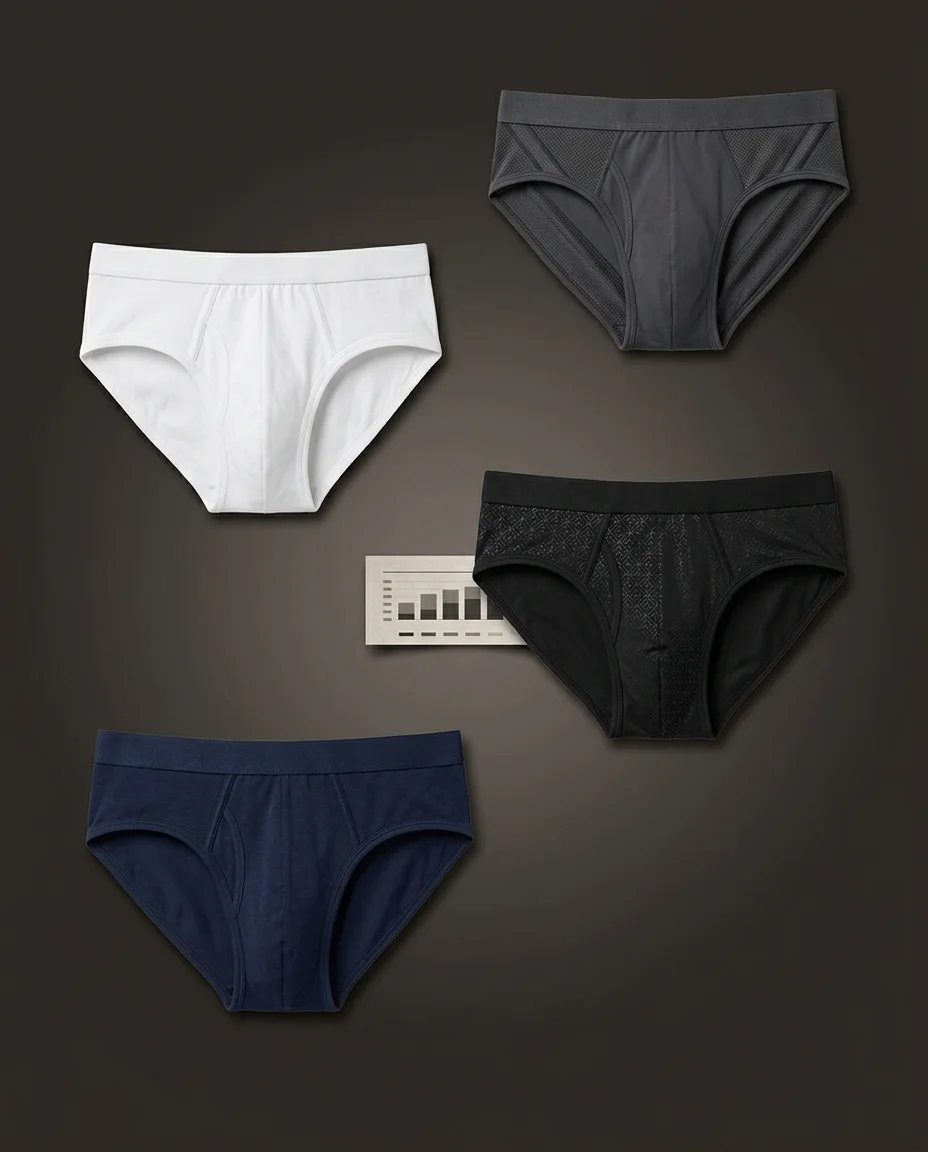
The men's underwear market split from one 'basics' category into four function-specific tracks — and the biggest entry filter is no longer design skill, it's MOQ arithmetic. This decision guide compares the four tracks (budget basics, functional tech, premium fabric, performance sport) with 2026 search data, per-track technology requirements and entry costs — and shows how a two-step sourcing ladder (test at 100 pieces ready-stock private label, scale at 500 pieces full OEM/ODM, vs the industry's 2,000+ norm) changes which track a new brand can actually afford to enter.
You've got your business plan. You've registered your company. You know your target customer. Now comes the part where most brand founders stumble: turning your product vision into physical inventory that meets your quality standards.
While our guide to starting a lingerie business covers entity formation, financial planning, and market validation, this article is your manufacturing playbook — the technical roadmap from tech pack to first shipment.
This is the guide that fills the gap between "I want to start a brand" and "I have 500 units of quality product ready to sell." We'll cover:
By the end, you'll understand exactly what happens between placing an order and receiving your first shipment.
Your first manufacturing decision sets the trajectory for your entire brand. OEM and ODM represent fundamentally different approaches to product creation — and choosing wrong can cost you months of delay and thousands in wasted development costs.
ODM is your smartest starting point if:
With ODM, you select from the manufacturer's proven designs — styles that have already sold successfully for other brands. You can customize colors, materials (within available options), and apply your branding. The trade-off is that other brands may access similar designs, limiting your differentiation.
OEM makes sense when:
OEM gives you complete control over every aspect of the product — fit, materials, construction, finishing. Your design belongs to you exclusively. In the broader industry this control comes with higher MOQ requirements (typically 2,000+ units), longer development timelines (10-16 weeks), and greater upfront investment — though with XiaoTex full OEM starts at 500 units per color.
For a deeper comparison of manufacturing models including wholesale, see our Wholesale vs OEM/ODM guide.
A tech pack is the communication bridge between your vision and the factory's execution. Incomplete or vague tech packs are the #1 cause of production disasters — wrong measurements, incorrect materials, poor fit, and expensive re-sampling rounds.
A professional tech pack eliminates ambiguity. The factory should be able to produce exactly what you want without additional clarification.
For design-focused guidance on creating your brand identity and product concept, see our guide on how to create your own lingerie brand.
The timeline from tech pack to approved sample varies dramatically depending on your manufacturing model and the factory's capabilities. Understanding this timeline helps you plan your launch date realistically.
Days from tech pack submission to approved production sample
Factories with rapid prototyping can deliver ODM samples in 3-7 days because they maintain:
This infrastructure investment enables startups to iterate quickly and launch faster.
These factors extend sample development to 4-8 weeks:
Plan for longer timelines if your design requires any of these factors.
Understanding each production stage helps you set realistic timelines, identify potential bottlenecks, and communicate effectively with your manufacturer.
| Order Type | Total Production Timeline | Key Variables |
|---|---|---|
| Ready-Stock Private Label (100 units) | 1-2 weeks | In-stock products, your label applied in as fast as 7 days |
| ODM Custom (500 units) | 6-8 weeks | Factory base designs, material and color changes |
| OEM Custom (500 units) | 8-16 weeks | Full development cycle to your tech pack |
For detailed fabric testing methodology, see our guide on fabric quality testing.
Quality issues that escape detection during production become expensive problems after shipment — returns, negative reviews, and damaged brand reputation. These 9 checkpoints catch problems before they reach your customers.
Before cutting begins, verify: GSM matches specification (weigh sample swatch), composition testing (fiber content matches claim), color matching against approved standard (light booth evaluation), and visual inspection for defects (holes, runs, discoloration).
Pre-shrink fabric before cutting to prevent post-production shrinkage. Test method: mark a 50cm x 50cm square, wash and dry per care instructions, measure shrinkage percentage. Acceptable: <3% shrinkage. Critical: document results for each fabric batch.
Test that dyes won't bleed or fade. Wash test: wash fabric with white fabric, check for color transfer. Rub test: rub wet and dry fabric with white cloth, check for color transfer. Light test: expose to UV light, check for fading. Required for compliance with most retail standards.
Verify pattern pieces match specifications: measurement of key dimensions, pattern alignment for printed fabrics, size grading accuracy (each size proportionally correct), and fabric utilization efficiency. Cutting errors multiply through production — catch them early.
Quality checks every 2 hours during production: seam strength (pull test), stitch density (stitches per inch), correct thread tension, and construction accuracy (seams in correct position). Document findings and address issues immediately — don't wait until production ends.
Consistent elastic tension determines waistband comfort and longevity. Test method: stretch elastic to specified extension, measure required force. Verify consistency across production run — variation indicates machine or material inconsistency. Poor tension = digging or sagging.
Measure finished pieces against specification: compare to tech pack measurements, verify tolerance compliance (+/-0.5cm typical), check across multiple pieces from different production times, and document measurements for each size. Pattern drift during production causes fit issues.
Wash finished garments per care instructions, then measure again. This catches: residual shrinkage, color fastness issues under real conditions, seam durability, and elastic recovery. Critical for preventing customer complaints after first wash.
Complete inspection before shipment: visual defects (loose threads, uneven stitching, marks), correct labeling (size, care instructions, brand), packaging compliance (fold, presentation, hang tags), and quantity verification. Pre-shipment photos protect both factory and buyer.
The final inspection is your last line of defense. Once goods ship, returning them is expensive and time-consuming. Pre-shipment inspection allows you to:
Never skip pre-shipment inspection, even for small orders. The cost of inspection is a fraction of the cost of receiving defective products.
For compliance and testing support, we coordinate with accredited third-party laboratories like SGS and Intertek for specific orders. This provides documentation for your target market's requirements without requiring OEKO-TEX or BSCI certifications.
Understanding where your money goes helps you make informed decisions about MOQ, customization level, and manufacturing partner. All pricing below reflects FOB (Free on Board) costs — the price you pay the factory for finished products ready to ship.
Typical FOB per unit including product, branding, and packaging
Ready stock prices at $1.00-1.50 because the product is manufactured in advance at scale — you only add your label. Custom at 500 pieces prices at $1.50-3.00 because it is made to your specification, and where you land inside the band depends on fabric system, construction depth, and customization level. Unit price at any factory always moves with volume (fabric utilization, setup amortization, supplier quantity breaks) — so compare prices at the same volume, and compare MOQ ladders across factories. Ours is 100/500 while the industry holds at 2,000+.
Production efficiency — Sewing operators work faster on longer production runs (learning curve effect). Setup time between operations is amortized across more pieces.
Material purchasing power — Factories can negotiate better fabric prices for larger quantities.
For strategies on balancing MOQ with startup constraints, see our guide on balancing MOQ and production costs for startup brands.
Learning from others' mistakes saves you time, money, and frustration. Here are the most common errors first-time brand founders make — and how to avoid them.
The mistake: Assuming fabric is pre-shrunk or that shrinkage is negligible.
The consequence: Customers complain their underwear shrinks after the first wash. Returns spike. Reviews mention "smaller than expected" or "shrank immediately."
The solution: Always require pre-shrinkage treatment before cutting. Request shrinkage test results for each fabric batch. Accept <3% shrinkage for standard products, <2% for premium positioning.
The mistake: Assuming the factory will choose appropriate stitch types, or using vague terms like "quality stitching."
The consequence: Inconsistent quality, uncomfortable seams, durability issues. Factory may use budget stitch types to reduce costs.
The solution: Specify exact stitch types in your tech pack: four-needle six-thread for side seams, cover stitch for hems, zigzag for elastic attachment. Include stitch density (stitches per inch) requirements.
The mistake: Ordering equal quantities across 6+ sizes (XS-XXL) for your first production run.
The consequence: Some sizes sell out immediately while others sit unsold. Capital tied up in slow-moving inventory. Skewed size data makes reordering difficult.
The solution: Start with 4 core sizes (S, M, L, XL) in ratios based on market data: typically 1:2:2:1 for S:M:L:XL. Expand size range after validating demand patterns.
The mistake: Expecting exact measurements without specifying acceptable tolerances.
The consequence: Unnecessary disputes with factory over minor variations. Rejection of acceptable products. Delays while samples are re-measured.
The solution: Specify tolerances in your tech pack. Standard tolerance for underwear: +/-0.5cm for most measurements, +/-0.3cm for elastic width. Accept products within tolerance; reject only those outside tolerance.
The mistake: Assuming production quality matches sample quality without verification.
The consequence: Surprises when goods arrive — different packaging, visible defects, color variations. Dispute resolution becomes difficult without pre-shipment documentation.
The solution: Always request pre-shipment photos showing: finished products (multiple angles), packaging, labels, and any known issues. Approve in writing before shipment. Photos protect both parties.
You've absorbed a lot of information. Here's your step-by-step action plan to move from concept to production.
Starting an underwear brand is a journey from concept to physical product. The difference between brands that succeed and those that struggle often comes down to manufacturing execution — not design, not marketing, but the ability to consistently produce quality products at viable costs.
At XiaoTex, we support startups and growing brands with flexible manufacturing solutions:
Start with the tier that matches your stage. Validate demand at 100 units. Differentiate and scale at 500 units — a proven style moves up the ladder four times earlier than the industry norm.
Explore Our Partnership Program
Sources and Further Reading: