Supply Chain Strategy2026-03-2012 min read
Wholesale vs. OEM/ODM: Which Manufacturing Model is Best for Your Brand?
Paul PengFactory Technology Director
Part of the Manufacturing Solutions series
Part of the Manufacturing Solutions series
Business insights for apparel brand owners, from production strategies to manufacturing optimization
Services and solutions for your business
Cotton, Modal, and Laser-cut panties in stock. Add your brand label in 7 days. From just 100 pieces.
Learn MoreReady-stock boxer briefs with your label from 100 pieces (7-day dispatch). Full OEM/ODM custom manufacturing from 500 pieces — while the industry asks 2,000+.
Learn More
Buyers read MOQ as a quality signal — '100 pieces must mean a garage operation; 5,000 pieces must mean a serious factory.' Both inferences are wrong. MOQ is regional production economics, not craftsmanship: Vietnam's full-package giants state 5,000-10,000 pieces per style (Thygesen's published rate), Bangladesh export lines run 1,000-5,000, and the wider industry asks 2,000+ — while China's Pearl River Delta clusters hold ready-stock fabric and mixed small-batch lines that make 100-piece private label ($1.00-1.50/piece) and 500-piece-per-color OEM ($1.50-3.00/piece) commercially real. This guide breaks down the line economics behind each number, what 'low MOQ' actually costs you in trade-offs, and the 100 → 500 test-and-scale ladder for underwear brands.

'Which country is best for apparel manufacturing?' costs brands money every time it gets asked — because the answer is a function of three variables, not one: your order stage, your category, and your destination market. Change any one and the correct country flips. This framework walks the three stages (100-piece private-label tests, 500-piece-per-color OEM scaling, 2,000+/10,000+ mass replenishment), maps categories to countries (underwear and fit-driven knits vs. cotton basics vs. performance synthetics), prices in the 2025 tariff reality (US-bound: 20% Vietnam / 20% Bangladesh / ≈45-55% China; RCEP markets: 0% on Chinese origin), and shows why 80%+ of US fashion companies now run dual-country sourcing instead of picking one winner.
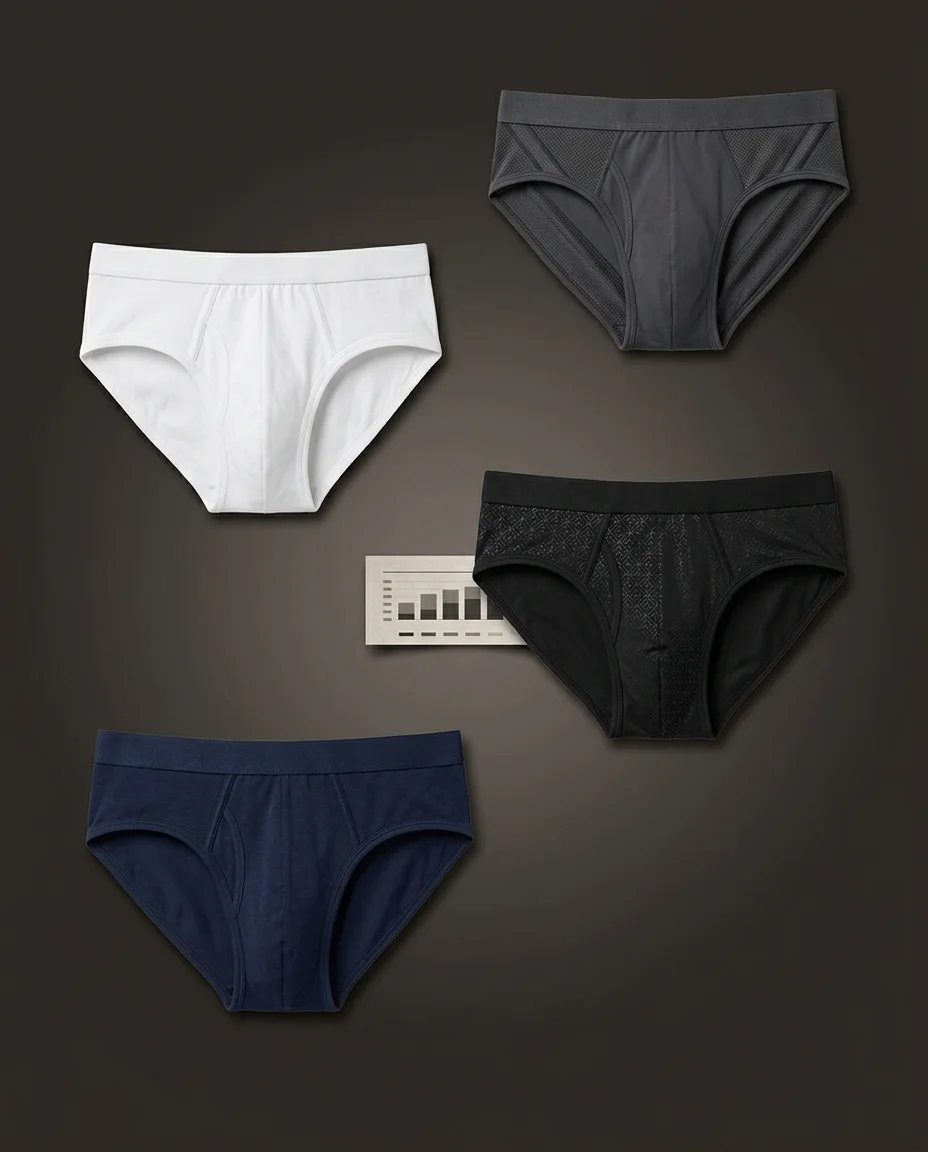
The men's underwear market split from one 'basics' category into four function-specific tracks — and the biggest entry filter is no longer design skill, it's MOQ arithmetic. This decision guide compares the four tracks (budget basics, functional tech, premium fabric, performance sport) with 2026 search data, per-track technology requirements and entry costs — and shows how a two-step sourcing ladder (test at 100 pieces ready-stock private label, scale at 500 pieces full OEM/ODM, vs the industry's 2,000+ norm) changes which track a new brand can actually afford to enter.
You're standing at a crossroads. You've validated your market, identified your target audience, and you're ready to launch your underwear brand. But now you face a decision that will determine your margins, your differentiation, and ultimately your success:
Should you buy wholesale, or should you manufacture your own products?
This isn't a theoretical question. The wrong choice can cost you $50,000 or more in lost opportunity, excess inventory, or market irrelevance.
Consider this: A D2C startup in Los Angeles spent $45,000 on wholesale inventory to launch quickly—only to discover they couldn't compete on price with established brands selling the same products. Meanwhile, a competitor invested $55,000 in OEM development, built a unique product line, and captured premium positioning that generated $200,000 in first-year revenue.
Both had similar budgets. Both were passionate. One chose wrong.
This article will give you the framework to choose right. We'll break down the three manufacturing models—wholesale, OEM, and ODM—with real cost structures, decision criteria, and strategic considerations specific to the underwear industry.
Loading video...
Before diving into the pros and cons, let's establish clear definitions. These terms are often used interchangeably, but they represent fundamentally different business relationships.
What it is: You purchase finished products directly from a manufacturer or distributor. No customization, no design input—just select from existing products and buy in bulk.
How it works:
Key characteristic: You're buying inventory, not creating products.
What it is: You provide complete product specifications and designs. The manufacturer produces exactly what you've designed using their equipment and expertise.
How it works:
Key characteristic: Full creative control, but you bear development costs and responsibility.
What it is: The manufacturer provides both the design and production. You select from their existing designs, potentially with minor customizations like colors or branding.
How it works:
Key characteristic: Speed and lower cost, but limited uniqueness.
Minimal Upfront Investment
Lightning-Fast Market Entry
No Design Expertise Required
Predictable Quality
Zero Product Differentiation
Thin Margins
Limited Control
Scale Limitations
Wholesale is ideal for:
Real example: A Shopify store owner tested three wholesale underwear styles with a $2,000 investment. After identifying the best-performing style, they transitioned to ODM production with custom branding, reducing their risk exposure significantly.
Complete Brand Differentiation
Higher Long-Term Margins
Quality Control at Every Step
Intellectual Property Protection
Substantial Upfront Costs
Extended Time to Market
Requires Technical Expertise
Higher Risk Exposure
OEM is ideal for:
Real example: A sustainable underwear brand invested $4,500 in OEM development for a proprietary bamboo-viscose blend with antimicrobial gusset technology. The unique product commanded $28 retail price (vs. $12-15 competitors) and generated $180,000 in Year 1 revenue with 75% gross margins.
Balanced Speed and Customization
Lower Risk Than OEM
Professional Design Without the Cost
Faster Iteration Cycles
Limited Differentiation
Weaker IP Protection
Compromise on Vision
Quality Uncertainty
ODM is ideal for:
Real example: A D2C startup tested five ODM styles with a $5,000 investment over 10 weeks. Two styles generated 80% of sales. They then invested $4,000 to develop those two styles as custom OEM products, reducing their total risk while accelerating market entry.

Choosing the right manufacturing model isn't about which is "best"—it's about which is best for your specific situation. Use this framework to make the right call.
| Budget Range | Recommended Model | Rationale |
|---|---|---|
| Under $5,000 | Wholesale | Lowest risk, fastest validation |
| $5,000-10,000 | ODM | Balance of customization and risk |
| $10,000+ | OEM | Full control for committed brands |
Pro tip: Don't spend your entire budget on production. Reserve 40-50% for marketing, inventory management, and unexpected costs.
If NO: Start with wholesale or ODM
If YES: Consider OEM
If MAYBE: Use ODM to develop expertise
Critical to Your Strategy → OEM
Moderately Important → ODM
Not Important → Wholesale
| Timeline | Model | Tradeoff |
|---|---|---|
| 2-4 weeks | Wholesale | Zero customization, but immediate |
| 6-10 weeks | ODM | Some customization, moderate speed |
| 11-19 weeks | OEM | Full customization, longer development |
Consider market timing:
Testing Phase (100-300 units)
Growth Phase (300-1,000 units)
Scale Phase (1,000+ units)

The most successful underwear brands don't commit to a single manufacturing model. They use all three strategically based on product lifecycle and market position.
Phase 1: Market Validation (Months 1-3)
Phase 2: Strategic Development (Months 4-6)
Phase 3: Brand Building (Months 7-12)
Total investment: $6,000-9,000 over 6 months Risk reduction: 60-70% vs. committing to OEM immediately
Core Line (60% of products): OEM
Trend Line (30% of products): ODM
Basics Line (10% of products): Wholesale
Result: Balanced risk, optimized margins, market agility
For startups, traditional MOQs (500-1,000 units) create inventory risk. Progressive manufacturers now offer low MOQ programs that change the equation entirely.
Benefits of Low MOQ (50-100 units):
Our approach at AuraTouchGlobal:
Real example: A first-time founder tested 6 styles with 50 units each ($4,500 total investment). Two styles sold out in 3 weeks. They re-ordered those two styles at 300 units each and discontinued the other four. Total loss on failed products: $1,500. Total gain on successful products: $12,000 profit in first quarter.
Your choice of manufacturing model is only half the equation. The other half is where you manufacture.
Concentrated Supply Chain
Experienced Workforce
Flexible Production Capabilities
Quality Assurance Infrastructure
While our facility does not currently hold OEKO-TEX or BSCI certifications, we provide robust quality assurance through:
There's no universally "best" manufacturing model. The right choice depends on your budget, expertise, timeline, and strategic goals.
Choose Wholesale if:
Choose ODM if:
Choose OEM if:
Choose Hybrid if:
Choosing the right manufacturing model is just the beginning. The real success comes from finding the right manufacturing partner—one who understands your vision, supports your growth stage, and provides the flexibility to evolve your approach.
For the full business roadmap beyond manufacturing — from legal formation and cash flow planning to the 100-unit market validation framework — see our complete guide to starting a lingerie business.
At AuraTouchGlobal, we support all three manufacturing models:
Our Starter Program offers flexible MOQs, fast sampling, and startup-friendly terms designed specifically for emerging brands and DTC entrepreneurs.
Ready to discuss which manufacturing model is right for your brand?
Contact us for a manufacturing consultation and let's explore how we can bring your underwear brand vision to life—whether you're testing your first 50 units or scaling to 10,000+ production runs.
The $50,000 question doesn't have to be a gamble. With the right framework and the right partner, it becomes a strategic decision that positions your brand for long-term success.
Sources and Further Reading: