Fabric Science2026-04-0610 min read
Modal vs Cotton: Moisture-Wicking Test (Modal Dries 50% Faster)
Karl XiaoFactory Production Director
Part of the The Fiber Lab series
Part of the The Fiber Lab series
Deep dive into fabric composition, properties, and performance at the microscopic level
Ready-to-ship product series related to this article
Services and solutions for your business

Every men's underwear brand asks the same three-way question and gets a marketing answer. This duel compares Modal, cotton, and bamboo boxer briefs across six measurable dimensions — hand feel, moisture, contact cooling, pilling grades, wash dimensional change, and FOB cost — using the grade limits from China's T/CTCA 12—2022 underwear standard, and settles the two questions buyers actually search: does modal boxer underwear pill, and are bamboo boxer briefs worth the premium (and the label).

Most 'cooling' men's underwear is nylon ice-silk: genuinely cool for the first 15 minutes, then a heat trap. This OEM guide separates marketing from measurable performance — the Q-max 0.15 W/cm² gate under GB/T 35263-2017, fabric-by-fabric benchmark ranges for Modal, Lyocell, and dual-layer constructions, the after-wash cooling test most brands skip, pouch and leg-opening engineering for real airflow, and three climate calendars covering US, Europe, Australia, and Middle East launch timing.

'Silk underwear' has no universal minimum silk content — a panty can carry the name with silk only in the gusset panel, at a single-digit percentage, sold at full-silk prices. China's new group standard for mulberry silk blended knitted underwear fabrics (released March 2026) finally draws two bright lines: at least 8% mulberry silk to be called a silk-blend underwear, at least 50% to be called silk knit underwear. We decode the naming rule, the fiber physics behind silk's zero-friction feel (a single continuous filament up to a thousand meters long, roughly 10-12 microns fine), why almost nobody makes 100% silk panties, the standard's testable benchmarks — antibacterial performance that must survive 50 washes (70% / 70% / 60% inhibition), burst strength over 250N, drip diffusion under 3 seconds, machine-wash shrinkage limits — and how to write them into a tech pack that survives FTC and EU fiber-labeling scrutiny.
Modal dries approximately 50% faster than cotton because its fiber diameter (1 dtex) is 50% finer than cotton (1.5–2.5 dtex), creating more capillary channels for faster moisture transport. Cotton absorbs sweat well but traps it inside hollow fibers; Modal wicks moisture to the surface where it evaporates quickly. For premium underwear, a 92% Modal / 8% Spandex blend offers the best combination of absorption, wicking speed, and drying time. The full comparison data — including dual-layer fabric engineering — is below.
Ever wonder why your cotton underwear feels damp and heavy after a workout, while performance fabrics stay dry? The answer lies in a fascinating scientific phenomenon called capillary action. Understanding this mechanism—combined with fiber structure—explains why cotton absorbs sweat but refuses to let it go, while engineered fibers like Modal manage moisture with superior efficiency. Let's dive into the science of moisture management.
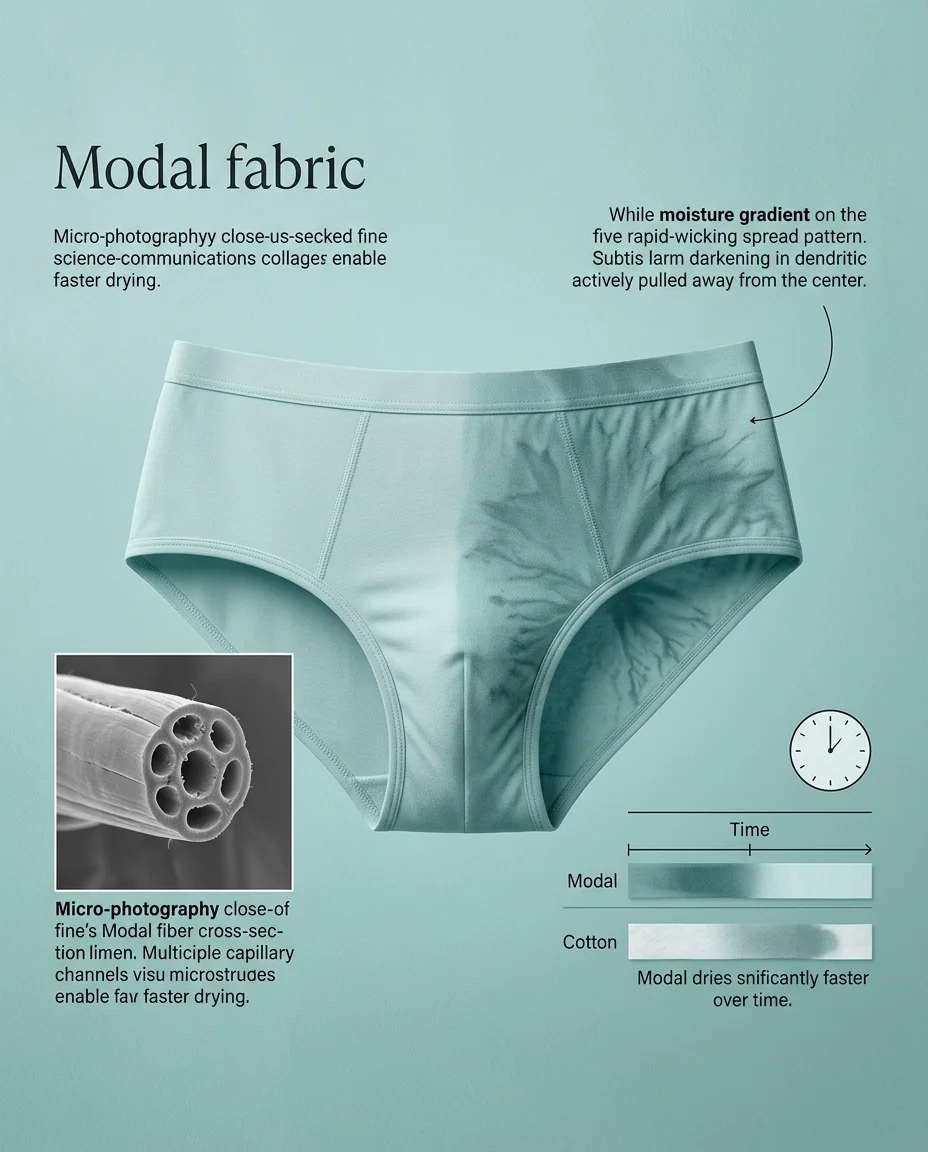
Cotton is nature's sponge—its hydrophilic (water-loving) cellulose structure gives it exceptional absorption capacity. A single cotton fiber can absorb up to 25 times its weight in water. This makes cotton excellent at initially capturing sweat. But here's the problem: cotton is too good at holding on to that moisture.
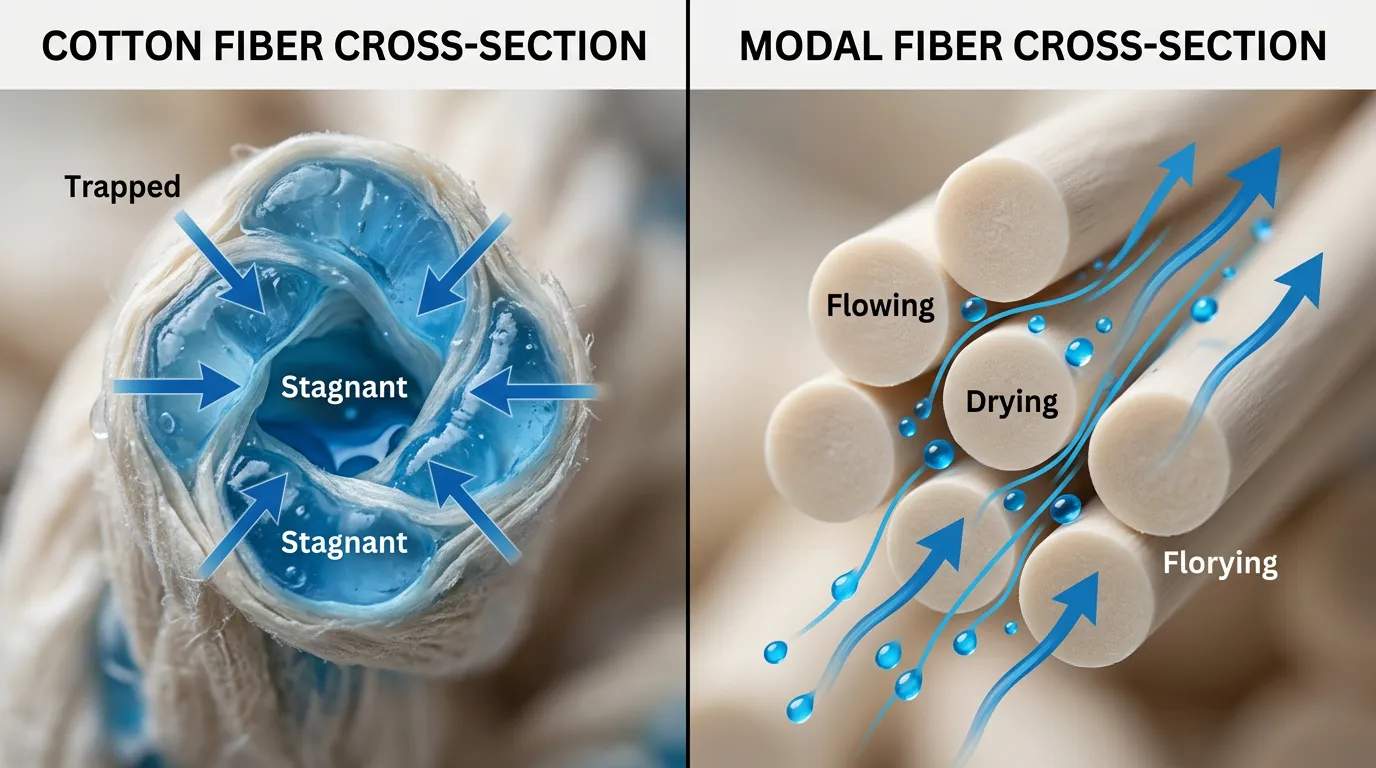
Imagine cotton fibers as tiny hollow tubes that fill up with water like a drinking straw. Once full, the water stays trapped until it slowly evaporates. During physical activity, cotton becomes saturated quickly—leaving you wearing a damp, heavy garment that feels uncomfortable and takes hours to dry completely.
Moisture management claims should be verified through standardized testing. AATCC 195 (Moisture Management Tester) and ISO 11092 (Sweating Guarded Hotplate) are the two primary standards used to quantify wicking speed, absorption rate, and drying time. Any brand making performance claims should be able to provide test results from one or both of these methods.
Capillary Action is the physical phenomenon that enables moisture-wicking fabrics to transport sweat away from your skin. It's the same principle that allows a paper towel to absorb a spilled drink or water to climb up a glass tube against gravity.
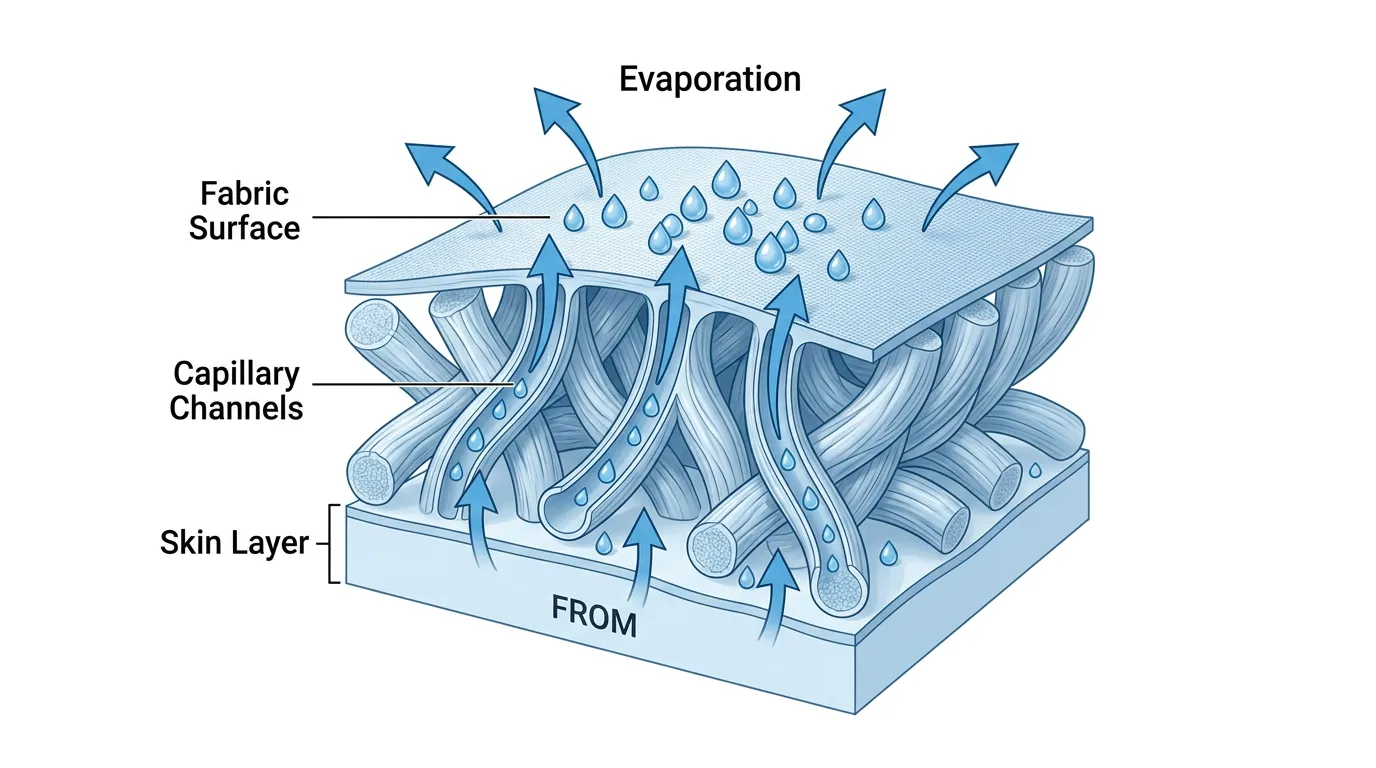
In textiles, capillary action occurs through the tiny spaces between fibers. These microscopic channels act like capillaries, pulling moisture along through surface tension and moving it from areas of high concentration (your sweaty skin) to areas of low concentration (the fabric surface).
Modal is a semi-synthetic cellulose fiber made from beechwood pulp. Like cotton, it's derived from natural plant cellulose—but it's engineered at the molecular level for superior performance. Modal achieves what cotton cannot: it absorbs moisture and releases it efficiently.
1dtex vs cotton's 1.5-2.5dtex = MORE capillary channels for faster wicking
Modal absorbs significantly more moisture than cotton by weight
Less friction = moisture glides along fibers faster
Open structure allows air circulation for faster drying
The secret lies in Modal's fiber structure. Because Modal fibers are 50% finer than cotton, they create more and smaller capillary channels. More capillaries mean more surface area for moisture transport—and faster wicking. Additionally, Modal's smoother surface creates less resistance, allowing moisture to glide along fibers more efficiently.
Not all "Modal" is created equal. Many suppliers claim Modal but ship coarser 1.5–2dtex fibers that do not deliver the same capillary performance. Always request fiber certification and laboratory verification of dtex ratings. The performance difference between true 1dtex Modal and 1.5dtex substitutes is measurable in standardized wicking tests.
Cotton traps water INSIDE hollow fibers (slow release). Modal's finer fibers create more capillary channels BETWEEN fibers (fast transport). Result: Modal wicks moisture to the surface where it can evaporate quickly, while cotton holds moisture inside where it feels damp against your skin.
Here's how these two fibers stack up when it comes to keeping you dry and comfortable:
Most articles compare cotton vs Modal as a simple either/or. But the real story involves three distinct moisture management systems, each with fundamentally different mechanisms:
For the science behind the spandex percentages mentioned here, see our Spandex in Underwear guide.
The jump from single-layer to dual-layer is not incremental — it is a qualitative shift. Single-layer Modal absorbs and wicks moisture, but the moisture stays within the fabric structure until it evaporates. Dual-layer construction creates an active transport system: the inner layer pulls moisture away from skin, then the outer layer channels it to the surface for evaporation.
Think of it like a water pump system: the inner Modal layer is the intake (pulling water from the source), and the outer synthetic layer is the outlet (releasing water to the air). Without both layers working together, moisture gets trapped inside the fabric.
For more on how elastic recovery interacts with moisture management, see our analysis of spandex blend performance.
Dual-layer construction requires separate knitting of two fabric layers with different fiber compositions, then bonding them together without adhesive (which would block moisture transport). This is a specialized manufacturing process that most budget factories cannot execute. The result is worth the cost for premium positioning — it eliminates the damp feeling that even high-quality single-layer Modal can develop after extended wear.
If you have shopped for underwear online, you have probably seen "ice silk" (冰丝) marketed as a cooling, breathable fabric. Here is the uncomfortable truth: "ice silk" is not a fiber type. It is a marketing term.
The term originated in the 1990s as a commercial name for synthetic fabric blends — typically polyester or nylon mixed with a small percentage of Modal or viscose. The "cooling" sensation comes from the smooth surface of synthetic fibers, which conducts heat away from skin on first contact. But this effect is temporary:
Synthetic fibers feel cool against skin because they conduct heat efficiently. This sensation lasts 5–15 minutes, then the fabric reaches skin temperature.
Once warmed up, synthetic fibers trap heat and moisture against the body. Without the absorption capacity of natural or regenerated cellulose fibers, sweat has nowhere to go.
Budget "ice silk" underwear typically uses low-denier synthetic fibers that pill, deform, and lose their smooth hand feel after 10–20 washes.
The bottom line: If you want genuine cooling performance, look for Modal (92%) + Spandex (8%) blends or dual-layer constructions — not "ice silk" marketing labels.
Pure cotton is dangerous during outdoor activities in cold or variable weather conditions. Cotton absorbs sweat into its hollow fibers but does not release it efficiently. When wet cotton is exposed to wind or dropping temperatures, it accelerates body heat loss — a leading cause of hypothermia in outdoor recreation. This is why outdoor professionals insist on moisture-wicking fabrics (Merino wool, synthetic blends, or Modal-based fabrics) for any activity beyond casual walking.
Understanding moisture management comes down to one key principle: absorption alone isn't enough. Cotton is exceptional at absorbing sweat, but poor at releasing it. Modal combines natural cellulose comfort with engineered capillary action that transports moisture away from skin and speeds up evaporation.
For intimate apparel and activewear, this difference matters. Underwear that traps moisture creates an unhealthy microclimate—damp, warm, and conducive to bacterial growth. The moisture microclimate in the gusset area is particularly important — learn more in our guide to gusset design and health. Modal's superior wicking and breathability maintain a drier, healthier environment next to your skin.
When sourcing underwear or activewear, look beyond "natural fiber" marketing. Consider the full moisture management equation: Absorption + Wicking Speed + Evaporation Rate = Comfort. Modal excels at all three—which is why it's increasingly the fiber of choice for premium intimate apparel that needs to keep you comfortable through long days and active lifestyles.
Ready to take your brand to the next level? Read our comprehensive guide on waistband engineering for brand owners: Ergonomic Waistband Tension: Eliminating 'Digging' Returns in Your Underwear Line.
Learn about waistband construction standards, elastic specifications, and how proper waistband engineering can reduce return rates and improve customer satisfaction.
Sources: This article is based on textile engineering research on moisture management in cellulose fibers, capillary action studies in moisture-wicking fabrics (AATCC 195, ISO 11092 standards), Modal fiber technical specifications from Lenzing AG, and comparative analysis of cotton vs. Modal moisture transport properties in textile research literature.