Fabric Science2026-09-0811 min read
Modal vs Cotton vs Bamboo Boxer Briefs: The 6-Dimension OEM Fabric Duel (Pilling, Cooling, Cost)
Paul PengFactory Technology Director
Part of the The Fiber Lab series
Part of the The Fiber Lab series
Deep dive into fabric composition, properties, and performance at the microscopic level
Ready-to-ship product series related to this article
Services and solutions for your business

Most 'cooling' men's underwear is nylon ice-silk: genuinely cool for the first 15 minutes, then a heat trap. This OEM guide separates marketing from measurable performance — the Q-max 0.15 W/cm² gate under GB/T 35263-2017, fabric-by-fabric benchmark ranges for Modal, Lyocell, and dual-layer constructions, the after-wash cooling test most brands skip, pouch and leg-opening engineering for real airflow, and three climate calendars covering US, Europe, Australia, and Middle East launch timing.

'Silk underwear' has no universal minimum silk content — a panty can carry the name with silk only in the gusset panel, at a single-digit percentage, sold at full-silk prices. China's new group standard for mulberry silk blended knitted underwear fabrics (released March 2026) finally draws two bright lines: at least 8% mulberry silk to be called a silk-blend underwear, at least 50% to be called silk knit underwear. We decode the naming rule, the fiber physics behind silk's zero-friction feel (a single continuous filament up to a thousand meters long, roughly 10-12 microns fine), why almost nobody makes 100% silk panties, the standard's testable benchmarks — antibacterial performance that must survive 50 washes (70% / 70% / 60% inhibition), burst strength over 250N, drip diffusion under 3 seconds, machine-wash shrinkage limits — and how to write them into a tech pack that survives FTC and EU fiber-labeling scrutiny.

Reversible pajamas — 'two looks in one set', flip it inside out and the satin face becomes a printed cotton face — are a merchandising gift to sleepwear brands: double the perceived value, a built-in 'for every mood' story, and a natural gift and travel product. What the product page never explains is that reversibility is a seam-engineering achievement, not a fabric choice. A true two-fabric reversible set runs on bagged-out seams and doubled seam allowances, tagless labels, two-way elastics, and trims finished on both faces — and it dies in the wash from one failure the spec sheet can predict: differential shrinkage between the two faces (cotton 3-5% vs satin 1-2%) puckering the seams after wash three. This guide maps the three reversible construction routes, the seam and trim engineering, the spec conflicts between the two faces, the cost reality, and the decision framework for brands considering a 2-in-1 sleepwear program.
Ask a supplier "which fabric is best for boxer briefs?" and you will get whichever fabric they have the most of in the warehouse. Ask the internet and you'll get three contradictory listicles. The honest answer is that the best fabric is a spec, not a name — and the three names buyers actually compare (modal, cotton, bamboo) differ in ways a lab bench can measure.
In boxer briefs, fabric choice is a climate-and-position decision with measurable consequences — not a comfort ranking. Modal beats cotton on moisture and contact cooling by instrument; cotton beats modal on dry structure and leg-opening grip; "bamboo" is mostly a regenerated cellulose fiber whose real advantages are hand feel and bacterial resistance, not the eco-magic its marketing implies. Any supplier ranking one as simply "best" is selling inventory, not engineering.
We make all three at our factory, so this duel has no home team. Six dimensions, real numbers, and the grade limits that decide whether a fabric should ship at all. For the four-way fiber-science comparison including lyocell, see our Modal vs Cotton vs Lyocell Decision Guide; this piece stays strictly inside the boxer brief use case — where leg-opening grip, pouch-zone climate, and ride-up interact with fabric choice in ways generic guides ignore.
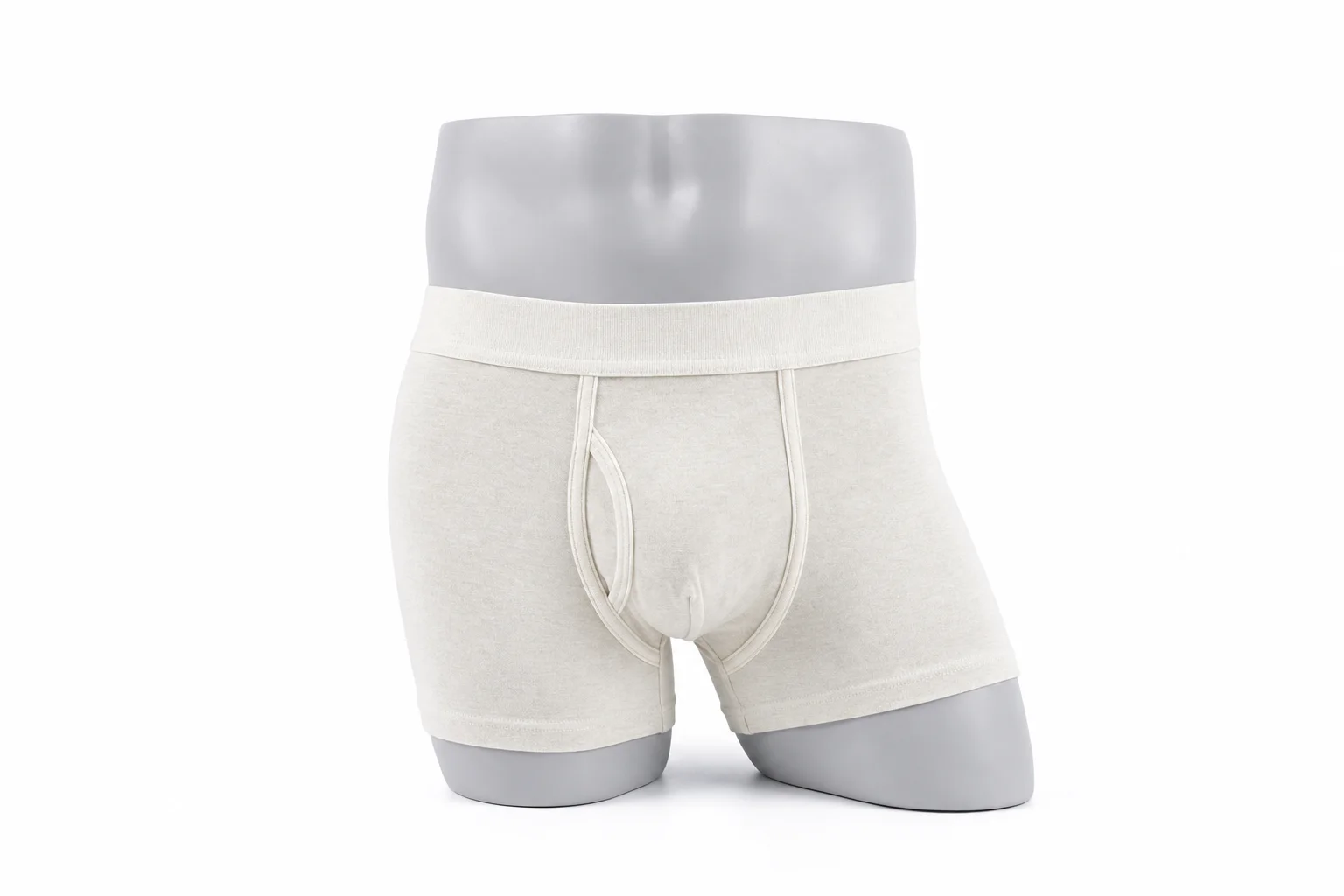
Combed cotton (95% cotton + 5% spandex). The classic. A 40S combed cotton body at ~170 g/m² is the workhorse spec — short-staple fibers combed free of impurities, knit into a dense, structured body. Cotton absorbs 8–10% of its weight in moisture, holds shape when dry, and survives hot washes.
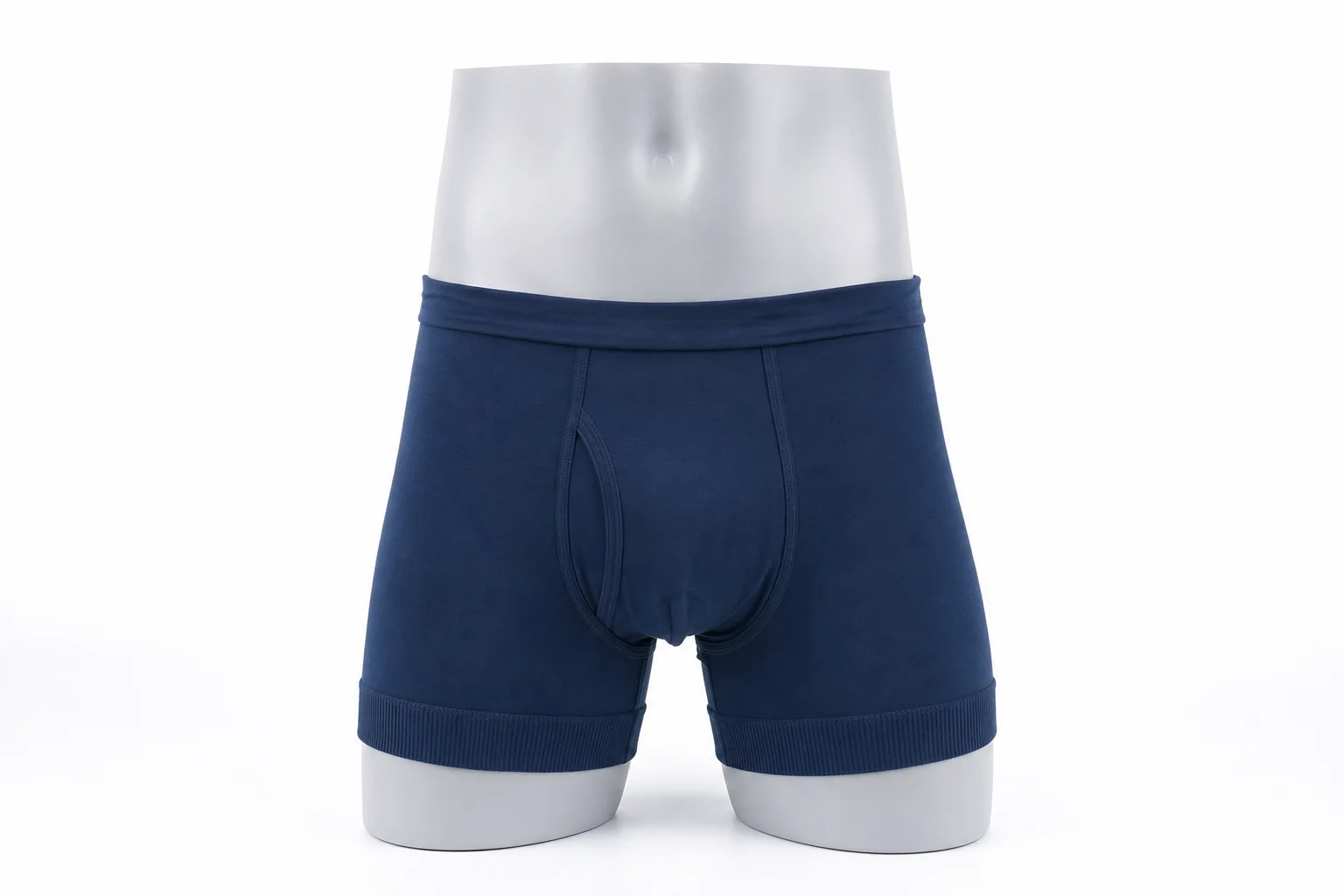
Modal (typically 92% modal + 8% spandex). A regenerated cellulose fiber (beech pulp base) with a finer, smoother filament than cotton — the fiber diameter runs smaller, the surface smoother. That geometry is why modal feels immediately softer and wicks faster: 12–15% moisture absorption and a cooler first touch.
"Bamboo" (overwhelmingly bamboo viscose). Also a regenerated cellulose fiber — bamboo pulp spun through the viscose process. Its fiber-level properties sit close to modal (soft, absorbent), with two genuine differentiators: naturally higher resistance to bacterial growth, and the strongest consumer-perceived eco story in the category. More on what the label should say below.
Pilling is the #1 fabric complaint in men's underwear reviews, and the grade limits are written down: under China's T/CTCA 12—2022 standard for soft-type underwear, fabric must reach pilling grade 3 or higher just to ship at the conforming level, with higher grades for first-quality and premium tiers.
What that means per fiber:
Write "pilling grade 3+ after 30 washes per T/CTCA 12—2022 test method" into the tech pack. Pilling is testable (the standard's method references Martindale-type friction testing), it is gradeable, and a supplier who won't commit to a number is telling you what they expect to ship.
The same standard grades dimensional change after washing: premium grade allows -3.0% to +1.5% lengthwise, first grade -4.0% to +2.0%, and conforming -5.0% to +2.5% (tested per GB/T 8630 laundering cycles).
This is not abstract quality paperwork — in boxer briefs it connects directly to the #1 fit complaint. Lengthwise shrinkage pulls the leg hem upward from the crotch side; fabric growth bags the body and drags the hem off the thigh. We break the full mechanism down in Why Boxer Briefs Ride Up. Fiber notes:
Instrument numbers (Q-max per GB/T 35263-2017 testing; moisture absorption by fiber weight):
For temperate markets the difference is a preference. For hot-climate markets — the Middle East, Australia, Southeast Asia, the US South — it is the product. A modal or bamboo-viscose body with a breathable waistband and a 3D pouch is a different wearing experience from cotton at 34°C. Our men's cooling boxer briefs guide covers the full hot-climate spec, including the after-wash cooling test most brands skip.
Cotton's counterpunch is dry structure: its firmer hand and heavier body keep leg openings gripping the thigh, which is why classic cotton boxer briefs ride up less than ultra-light modal styles on athletic thighs.
Two truths the bamboo category needs said plainly:
For positioning: buy bamboo viscose for the hand feel and the measurable antibacterial performance (ask for zone-of-inhibition test data per GB/T 20944 methods), and let the eco story be a footnote rather than the headline claim.
Fiber content disclosed exactly — including the gusset panel if it differs from the body.
Pilling grade 3+ (30-wash basis) per T/CTCA 12—2022 test method in the tech pack.
Dimensional change within -4.0% to +2.0% (first grade or better) — or your ride-up returns will tell you.
For hot markets: Q-max 0.15+ and moisture data quoted per fabric; after-wash values on request.
Safety compliance for the destination market, verified order-level if needed.
We manufacture all three contenders at our Zhongshan factory, which is why this duel names numbers instead of winners:
Choosing between the three for your market? Compare the men's series in the catalog or send us your target market and positioning for a fabric recommendation.
Related reading: Modal vs Cotton vs Lyocell: The 3-Way Decision Guide (generic four-fiber science) · Why Boxer Briefs Ride Up (leg hem engineering) · Men's Cooling Boxer Briefs: Q-max Guide (hot-climate specs) · Bamboo Underwear: Lab Data vs Marketing · Does Modal Loungewear Pill? (pilling engineering next door).
Sources: China Textile Commerce Association group standard T/CTCA 12—2022 《柔软型内衣》 — pilling grade floor, dimensional change grade limits (-3.0/+1.5, -4.0/+2.0, -5.0/+2.5% lengthwise), burst strength floors, and test methods (GB/T 8630 laundering), quoted from the indexed full text; Q-max values and moisture absorption ranges per fiber cross-referenced from our GB/T 35263-2017-based fabric testing program as compiled in the men's cooling guide; bamboo viscose process and labeling requirements per US Textile Fiber Products Identification Act (16 CFR 303) and EU Regulation 1007/2011 naming rules, with process-chemistry context (carbon disulfide in viscose spinning) from standard textile-chemistry references; antibacterial evaluation methods per GB/T 20944 series; price bands anchored to our published MOQ-tier ranges (ready-stock $1.00-1.50, OEM 500pcs $1.50-3.00, industry 2,000pcs $1.00-1.75 per piece), with per-fabric positioning within the OEM band from factory cost accounting 2025-2026. Grade claims reflect the cited standard's thresholds; actual results vary by yarn, knit density, finish, and dye lot.