Fabric Science2026-09-0813 min read
Men's Cooling Boxer Briefs: Q-max Tiers, Ice-Silk Myths, and the Fabric Specs Brands Should Buy
Karl XiaoFactory Production Director
Part of the The Fiber Lab series
Part of the The Fiber Lab series
Deep dive into fabric composition, properties, and performance at the microscopic level
Ready-to-ship product series related to this article
Services and solutions for your business
Ready-stock boxer briefs with your label from 100 pieces (7-day dispatch). Full OEM/ODM custom manufacturing from 500 pieces — while the industry asks 2,000+.
Learn MoreMen's and women's underwear ready to dispatch. Choose from 6 fabric series. Add your brand label in 7 days.
Learn More
Every men's underwear brand asks the same three-way question and gets a marketing answer. This duel compares Modal, cotton, and bamboo boxer briefs across six measurable dimensions — hand feel, moisture, contact cooling, pilling grades, wash dimensional change, and FOB cost — using the grade limits from China's T/CTCA 12—2022 underwear standard, and settles the two questions buyers actually search: does modal boxer underwear pill, and are bamboo boxer briefs worth the premium (and the label).

'Silk underwear' has no universal minimum silk content — a panty can carry the name with silk only in the gusset panel, at a single-digit percentage, sold at full-silk prices. China's new group standard for mulberry silk blended knitted underwear fabrics (released March 2026) finally draws two bright lines: at least 8% mulberry silk to be called a silk-blend underwear, at least 50% to be called silk knit underwear. We decode the naming rule, the fiber physics behind silk's zero-friction feel (a single continuous filament up to a thousand meters long, roughly 10-12 microns fine), why almost nobody makes 100% silk panties, the standard's testable benchmarks — antibacterial performance that must survive 50 washes (70% / 70% / 60% inhibition), burst strength over 250N, drip diffusion under 3 seconds, machine-wash shrinkage limits — and how to write them into a tech pack that survives FTC and EU fiber-labeling scrutiny.

Reversible pajamas — 'two looks in one set', flip it inside out and the satin face becomes a printed cotton face — are a merchandising gift to sleepwear brands: double the perceived value, a built-in 'for every mood' story, and a natural gift and travel product. What the product page never explains is that reversibility is a seam-engineering achievement, not a fabric choice. A true two-fabric reversible set runs on bagged-out seams and doubled seam allowances, tagless labels, two-way elastics, and trims finished on both faces — and it dies in the wash from one failure the spec sheet can predict: differential shrinkage between the two faces (cotton 3-5% vs satin 1-2%) puckering the seams after wash three. This guide maps the three reversible construction routes, the seam and trim engineering, the spec conflicts between the two faces, the cost reality, and the decision framework for brands considering a 2-in-1 sleepwear program.
Search "men's cooling underwear" in any hot-climate market and one term dominates the results: ice silk. It is also the term most likely to burn a brand.
Ice-silk boxer briefs genuinely feel cold on first touch — that part of the marketing is true. The Q-max instrument will confirm it: nylon-based ice silk posts the highest contact-cooling values of any underwear fabric, 0.18–0.22 W/cm². Then the wearer puts them on, and fifteen minutes later the same fabric that won the touch-test is trapping heat and moisture against skin for the rest of the day. The reviews say "cooling stops working"; the returns say the same.
"Ice silk" is a marketing term, not a fiber. There is no ice-silk fiber category in any textile nomenclature — most ice-silk products are nylon or polyester blends relying on contact cooling and finishes that fade with washing. A cooling boxer brief should be bought on four measurable numbers: Q-max (first-touch cooling), MVTR (breathability), air permeability, and after-wash Q-max (durability of the cooling claim). Any supplier who cannot quote them is selling a feeling, not a fabric.
This guide is for brands and buyers specifying men's cooling boxer briefs — the dominant men's style with 65%+ market share. We cover what the numbers mean, which fabric systems actually deliver, the construction details that create real airflow, and launch timing for the three climate calendars your market sits in. The search demand is real and still growing:
Functional men's underwear demand is outpacing generic products
"Men's cooling underwear" grew +90%, "best breathable underwear for men" +110%, and "moisture wicking underwear" +130% — while generic men's underwear searches declined 20–30%. The category is real. The question is whether your product passes the numbers.
Most brands approach men's cooling underwear by taking a women's design, making it in darker colors, and calling it "unisex." This misses three male-specific thermal challenges:
Men produce approximately 2x more sweat than women in the groin and inner thigh area during physical activity and in hot environments. A fabric that adequately manages women's moisture may be overwhelmed by men's sweat rates — especially in humid climates.
The pouch region in men's underwear creates a micro-environment with limited airflow. Temperature in this area runs 1–2°C higher than surrounding skin. Without deliberate ventilation design, even breathable fabrics trap heat in this zone.
Men's boxer briefs cover significantly more skin surface than women's briefs or thongs. More coverage means more fabric-skin interface, making breathability even more critical. A fabric with "moderate" breathability may be acceptable in a women's bikini but uncomfortable in a men's boxer brief.
This cooling trend is part of a broader shift toward functional specialization — heated underwear (+70% search growth), seamless construction (+300%), antibacterial treatments. See our Men's Functional Underwear Guide for the full market analysis.
Q-max is the peak heat flux when fabric first touches skin — the "wow, cool" number, measured in W/cm² under China's GB/T 35263-2017 test standard (KES-F7 Thermo Labo instrument or equivalent). The working threshold: 0.15 W/cm² or higher counts as genuine contact cooling. For the full testing methodology and how to verify supplier claims, see our Q-max Testing Guide for Brands.
But Q-max alone is how ice silk wins touch-tests and loses customers. Specify all four:
Chinese cooling-textile grading already treats wash durability as a first-class requirement: adjacent-category cooling standards grade the contact-cooling coefficient pre-wash and post-wash separately, re-testing after 10 cycles of standard washing. Premium grades must hold their Q-max tier after washing, not just fresh out of the bag. Adopt the same logic in your spec: a supplier quoting only a new-fabric Q-max is quoting the number that dies in the laundry.
Based on lab testing data and production experience, three fabric systems work for men's cooling boxer briefs — each suited to different market positions and price points.
Modal 92/8 is the most versatile choice: good contact cooling, excellent moisture management, and a soft hand feel men prefer for all-day wear.
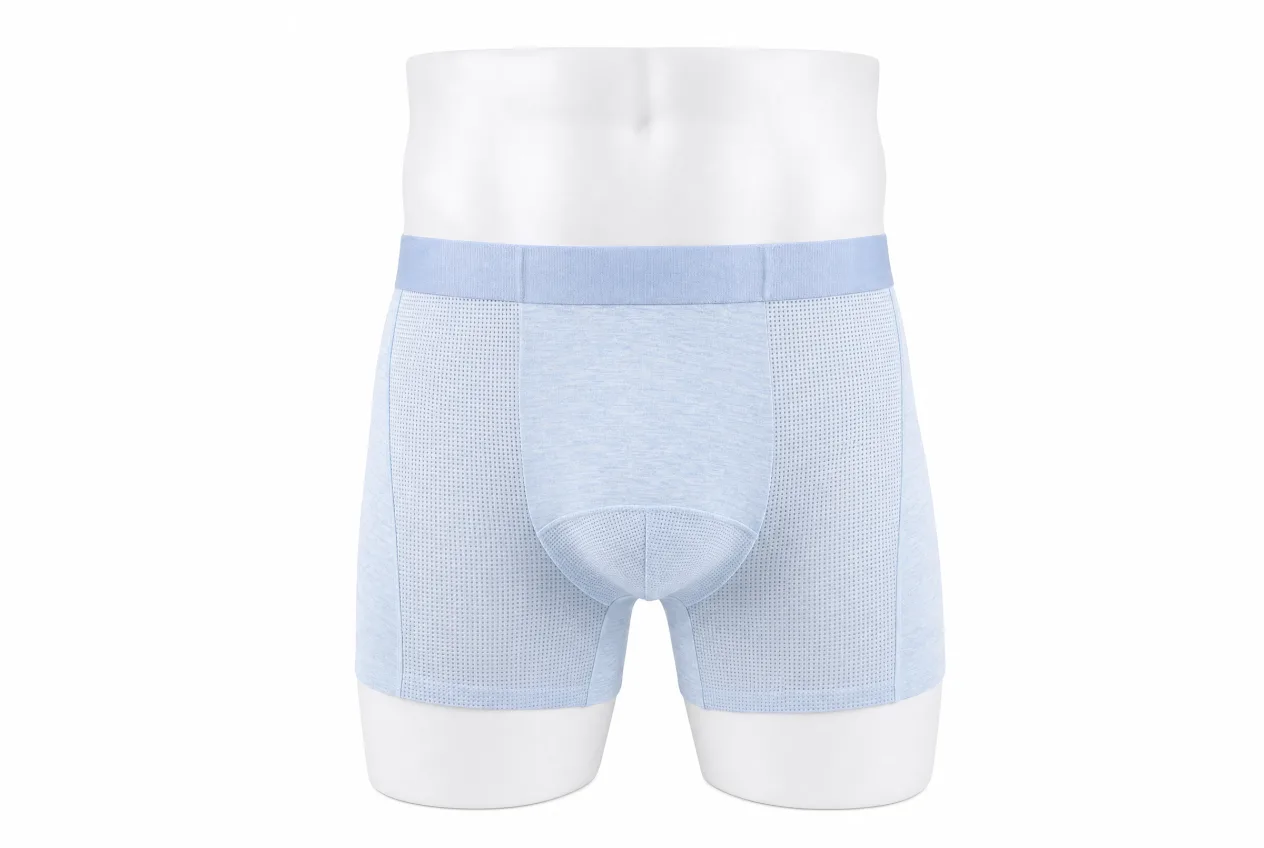
Design recommendation: boxer briefs and trunks for daily wear; pair with a 100% Modal or cotton gusset in the pouch region. See our men's modal boxer briefs series for stocked blocks.
Lyocell offers the highest overall cooling performance, particularly in sustained heat dissipation. Its nanofibril structure creates microscopic air channels with continuous airflow.
Design recommendation: premium boxer briefs for hot-climate markets — the Middle East, Southeast Asia, the southern US, and Australia. Price at $25+ retail.
Dual-layer construction separates moisture absorption and transport into two layers, solving the high-sweat-volume challenge:
Inner layer (Modal 92/8): contacts skin, absorbs sweat rapidly (12–15% absorption rate), and wicks moisture outward through capillary action.
Outer layer (nylon mesh or polyester): receives moisture from the inner layer, spreads it across a larger surface for rapid evaporation, and provides structural support.
Combined effect: a continuous moisture gradient that moves sweat away from skin — far more effective than any single-layer fabric for high-sweat applications.
Do not reverse the layers. The Modal (or Lyocell) must be the inner layer touching skin. If nylon is the inner layer, it will feel cool initially but trap moisture — recreating the "ice silk" problem. The outer nylon layer should be a lightweight mesh (not a solid film) to allow air circulation.
Beyond fabric, three construction elements decide whether a cooling boxer brief actually breathes on a body:
In our production testing, switching from a flat front panel to a 3D molded pouch reduced perceived heat by approximately 1–1.5°C in wear trials — without changing the fabric. The pouch creates an air gap that allows convective cooling, which fabric alone cannot provide.
Leg openings are a critical cooling failure point — and a ride-up failure point at the same time. The two goals trade off:
For the full construction analysis — leg hem elastic width, the 1.5× leg-opening stretch floor, and the 30-wash acceptance protocol — see our Boxer Briefs Ride-Up OEM Spec Guide, and the Ergonomic Waistband Tension Guide for waistband pressure math.
The men's cooling market is dominated by "ice silk" products — nylon or polyester blends with high Q-max values but poor sustained performance. That is the credibility gap a new brand can exploit:
For the ice-silk term itself — where it came from and what legally replaces it on a label — see "Ice Silk" Underwear Exposed and the lab-data comparison in Ice Silk vs Real Cooling Fabrics.
Cooling is seasonal — but the season depends on which hemisphere (or non-season) your market sits in. Most brands plan only one calendar and leave two unserved:
Two implications most sourcing calendars miss:
Because ready-stock private label starts at 100 pieces, you can run a market test in one climate window and reorder into the next without a 6-month commitment. Testing in Australia in November, then rolling the proven block into a Middle East White Friday program, is a two-market year off a single development cycle.
The fastest way to evaluate cooling systems is to test fabrics in hand. We provide free cooling fabric sample kits for brands:
XiaoTex is an OEM/ODM underwear factory in Zhongshan, Guangdong — the Pearl River Delta manufacturing belt. Men's cooling boxer briefs are one of our four stocked men's programs:
Request free cooling fabric samples, explore the men's cooling series, or send us your target market and spec for a quote.
Related articles:
Sources: Q-max threshold and fabric benchmark ranges (nylon ice-silk 0.18–0.22, Lyocell 0.15–0.18, Modal 0.14–0.17, cotton 0.11–0.14 W/cm²; 0.15 W/cm² working threshold) per GB/T 35263-2017 《纺织品 接触瞬间凉感性能的检测和评价》 as compiled in our Q-max testing guide; after-wash cooling durability logic adapted from China Textile Commerce Association cooling-textile grading, which re-tests the contact-cooling coefficient after 10 wash cycles per GB/T 8629-2017 and grades pre-wash and post-wash values separately (adjacent-category group standards for cooling textile products, indexed full text); sweat-rate differentials, pouch-zone temperature differential, and fabric system test data (Q-max, MVTR, air permeability, 50-wash retention) from our earlier fabric testing program; search growth figures from Google Trends exports for cooling/underwear topics (worldwide, 2025–2026 windows, internal research archive); boxer brief market share and pricing from third-party market estimates and factory FOB quotes, 2026. Performance claims reflect cited standards' thresholds; actual results vary by fabric lot, finish, and laundering conditions.