Brand Growth2026-08-1312 min read
How to Start a T-Shirt Brand in 2026: POD vs OEM (With the True Classic $3K Playbook)
Leo PengTechnical Advisor
Part of the Manufacturing Solutions series
Part of the Manufacturing Solutions series
Business insights for apparel brand owners, from production strategies to manufacturing optimization

Buyers read MOQ as a quality signal — '100 pieces must mean a garage operation; 5,000 pieces must mean a serious factory.' Both inferences are wrong. MOQ is regional production economics, not craftsmanship: Vietnam's full-package giants state 5,000-10,000 pieces per style (Thygesen's published rate), Bangladesh export lines run 1,000-5,000, and the wider industry asks 2,000+ — while China's Pearl River Delta clusters hold ready-stock fabric and mixed small-batch lines that make 100-piece private label ($1.00-1.50/piece) and 500-piece-per-color OEM ($1.50-3.00/piece) commercially real. This guide breaks down the line economics behind each number, what 'low MOQ' actually costs you in trade-offs, and the 100 → 500 test-and-scale ladder for underwear brands.

'Which country is best for apparel manufacturing?' costs brands money every time it gets asked — because the answer is a function of three variables, not one: your order stage, your category, and your destination market. Change any one and the correct country flips. This framework walks the three stages (100-piece private-label tests, 500-piece-per-color OEM scaling, 2,000+/10,000+ mass replenishment), maps categories to countries (underwear and fit-driven knits vs. cotton basics vs. performance synthetics), prices in the 2025 tariff reality (US-bound: 20% Vietnam / 20% Bangladesh / ≈45-55% China; RCEP markets: 0% on Chinese origin), and shows why 80%+ of US fashion companies now run dual-country sourcing instead of picking one winner.
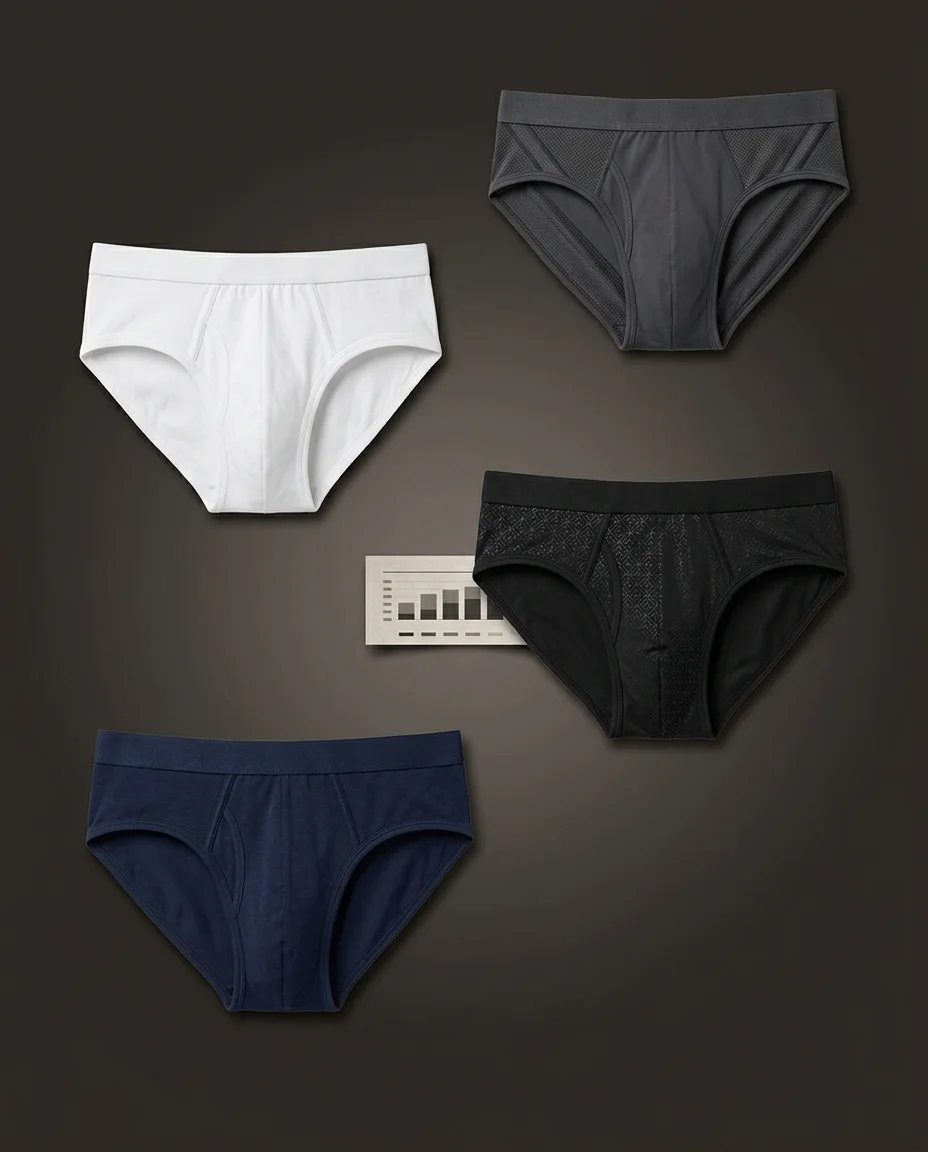
The men's underwear market split from one 'basics' category into four function-specific tracks — and the biggest entry filter is no longer design skill, it's MOQ arithmetic. This decision guide compares the four tracks (budget basics, functional tech, premium fabric, performance sport) with 2026 search data, per-track technology requirements and entry costs — and shows how a two-step sourcing ladder (test at 100 pieces ready-stock private label, scale at 500 pieces full OEM/ODM, vs the industry's 2,000+ norm) changes which track a new brand can actually afford to enter.
The T-shirt is the most accessible entry point in apparel — and in 2026, also one of the most profitable. Custom T-shirt printing runs at 12.81% CAGR (Fortune Business Insights) with operators reporting 50-70% gross margins. But accessibility cuts both ways: low barriers mean brutal competition, and most new T-shirt brands fail not because the design was bad but because the sourcing model was wrong for their stage.
This guide gives you the 8-step path to launch, a side-by-side comparison of Print-on-Demand vs OEM sourcing, and the moment when you should move from one to the other. It is anchored in the True Classic playbook — $3,000 in bootstrap capital, $800-$1,000 of it invested in quality samples and a tech pack — which is the cleanest documented case of a T-shirt brand built on product quality from day one.
Growth, margin, and the True Classic bootstrap benchmark
Before the steps, the principle. True Classic founder Ryan Bartlett bootstrapped with $3,000 in startup capital and grew it into a multimillion-dollar business. The single most-cited decision: investing $800-$1,000 in quality samples and a tech pack before doing anything else.
"Investing $800 to $1,000 in quality samples and tech packs was crucial. It helped the brand develop a product that addressed a real gap in the men's apparel market. True Classic bootstrapped with just $3,000 and grew into a multimillion-dollar business by prioritizing product quality from day one." — Shopify
The lesson is not about $3,000 — it is about inverting the usual sequence. Most new brands spend on ads first and product quality last. True Classic spent on product first, which meant the unit that finally ran through ads was good enough to earn repeat purchases. This is the exact philosophy behind low-MOQ OEM: a 100-piece run lets you put real product (your fabric spec, your label, your fit) in front of real customers before you scale.
The most important number in a T-shirt brand is not your ad budget — it is your reorder rate. Reorders come from product quality. The cheapest way to fail is to pour ad spend into a POD tee that customers buy once and never again. The cheapest way to succeed is to invest in a quality sample, validate it small, and scale what reorders.
Pick a niche — and narrow it. Avoid broad categories (funny tees, womens tees) where you fight large brands head-on. Granular niches win: not pet owners but California women who own Labradors; not sports fans but pickleball players. The more specific, the easier the marketing and the higher the conversion.
Validate the niche. Search Amazon and Etsy for best-sellers in the niche. Read the 1-3 star reviews — the complaints are your product gap. Use Google Trends, Keyword Planner, and Reddit to confirm demand is real and current, not imagined.
Choose your model: POD, wholesale private label, or OEM. This is the make-or-break decision (see comparison below). POD validates with zero inventory; OEM (100+ pieces) builds a real brand with lower unit cost and custom quality. Most brands use POD first, OEM second.
Source your blank or spec your fabric. Match fabric to print method up front (cotton for DTG/screen, polyester for DTF/sublimation). Quality beats price — a cheap blank kills reorders. This is where True Classic's sample investment pays off.
Design. Simple and distinctive beats complex. Tools: Canva, Adobe Express; or hire via Fiverr / Upwork for $20-$100 per design. Lead with one hero design per niche, not ten mediocre ones.
Price. Cost-plus (blank + print + software + marketing + margin) or value-based (price to perceived value). Custom-print margins run 50-70%. Price slightly below competitors to win first buyers, or premium if quality justifies.
Open your store. Shopify, WooCommerce, Etsy, TikTok Shop, or Amazon (FBA or Seller). For validation, a marketplace (Etsy/Amazon) gives you organic discovery; for brand building, your own Shopify store owns the customer relationship.
Market. Short-form video on Instagram/TikTok, micro-influencers (1k-10k followers — high targeting and credibility), and small paid tests ($5-$10/day) on what already sells organically. Do not scale paid until organic/email proves the product.
This is the single most important sourcing decision in a T-shirt brand, and the wrong choice for your stage is the most common cause of failure.
POD and OEM are not competitors — they are stages. POD is the cheapest way to find out if a design sells. OEM is the cheapest way to make money once it does. The brands that get stuck are the ones running POD at scale, paying premium unit cost and ceding branding control to a platform, when their validated designs deserve a real OEM run.
A clear niche is the single highest-leverage early decision. The Classic Dad case is the cleanest example: the brand makes dad-joke and nostalgia T-shirts for one specific customer — the back-yard-barbecue, pun-loving dad.
"A clear niche means higher conversions and lower ad costs — because you market to a defined audience with validated demand." — Printful
Granular niche examples that have worked:
The principle: narrow until you can picture a single person buying it. That specificity is what makes micro-influencer marketing and small ad budgets work — you can find the audience, and the audience self-selects.
The signal to upgrade is not a feeling — it is a measurable trigger. Move from POD to a 100-piece OEM/private-label run when all three are true:
You are reordering the same POD SKU regularly. The product is not a one-off; it has recurring demand. This is the validation POD exists to provide.
POD's per-unit premium is eating the profit you could be capturing. At ~100 pieces, OEM unit cost drops sharply while quality and branding rise.
Neck labels, hangtags, custom fabric, wash, packaging — the things that turn a POD print into a brand. POD cannot deliver these; a 100-piece private-label run can.
When those three align, run a 100-piece private-label test (existing body, your label, ~7-day shipping) to confirm the OEM product matches or beats the POD version in customer response. On the second reorder, move to 500-piece OEM/ODM with your design on in-stock fabric and full branding. This is the exact trajectory True Classic's quality-first philosophy maps onto.
The smartest brands we work with use the same fabric across the POD validation and OEM scale-up. Validate the design on a POD blank whose spec (cotton %, GSM) you can replicate at OEM; then when you scale to 100/500 pieces, the customer who reorders experiences the same — or better — fabric. A sudden fabric change between POD and OEM is the #1 cause of return spikes after a brand upgrades.
These ranges are indicative and depend on fabric spec, print method, order size, and channel. The point is the delta: moving from POD to OEM roughly doubles gross margin on the same retail price, while improving product quality and branding. That margin delta is what funds the marketing that grows the brand.
When deciding between cheap and quality fabric, use cost-per-wear, not sticker price.
The math: stronger fibers (organic cotton, no chemical exposure) survive more washes, so the premium tee costs less per wear and produces less waste. This is the argument that justifies investing in OEM quality rather than racing to the bottom on blank price — and the argument that converts your customers into repeat buyers.
XiaoTex is a T-shirt OEM/ODM factory in Zhongshan, Guangdong — the Pearl River Delta cluster behind China's 29% global T-shirt production share. We are built specifically for the brand upgrading from POD:
Starting a T-shirt brand in 2026 is cheap; building one that lasts is not. The True Classic $3K playbook distills to one principle: invest in product quality early, validate small, scale what reorders. Three rules:
If you have validated a design and are ready to move beyond POD, send us your tech pack and target MOQ — we will build the sample to spec and quote the 100- or 500-piece run that turns a POD print into a brand.
Data Sources: True Classic bootstrap case ($3,000; $800-$1,000 samples + tech pack) per Shopify 2026 T-shirt business guide; 8-step launch process synthesized from Shopify, Printify, and Printful 2026 guides; Classic Dad niche case per Printful; custom-print CAGR (12.81%) and operator margins (50-70%) per Fortune Business Insights (FBI114878) and Merchize; cost-per-wear model per OrangeBox industry analysis. Margin and unit-cost ranges are indicative industry figures.